EGYPTIAN
ARCHAEOLOGY
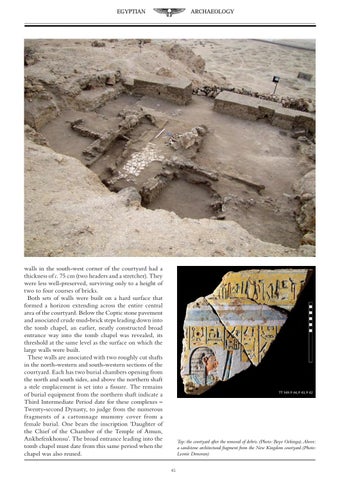
walls in the south-west corner of the courtyard had a thickness of c. 75 cm (two headers and a stretcher). They were less well-preserved, surviving only to a height of two to four courses of bricks. Both sets of walls were built on a hard surface that formed a horizon extending across the entire central area of the courtyard. Below the Coptic stone pavement and associated crude mud-brick steps leading down into the tomb chapel, an earlier, neatly constructed broad entrance way into the tomb chapel was revealed, its threshold at the same level as the surface on which the large walls were built. These walls are associated with two roughly cut shafts in the north-western and south-western sections of the courtyard. Each has two burial chambers opening from the north and south sides, and above the northern shaft a stele emplacement is set into a fissure. The remains of burial equipment from the northern shaft indicate a Third Intermediate Period date for these complexes – Twenty-second Dynasty, to judge from the numerous fragments of a cartonnage mummy cover from a female burial. One bears the inscription ‘Daughter of the Chief of the Chamber of the Temple of Amun, Ankhefenkhonsu’. The broad entrance leading into the tomb chapel must date from this same period when the chapel was also reused.
Top: the courtyard after the removal of debris. (Photo: Boyo Ockinga). Above: a sandstone architectural fragment from the New Kingdom courtyard.(Photo: Leonie Donovan) 41