EGYPTIAN
ARCHAEOLOGY
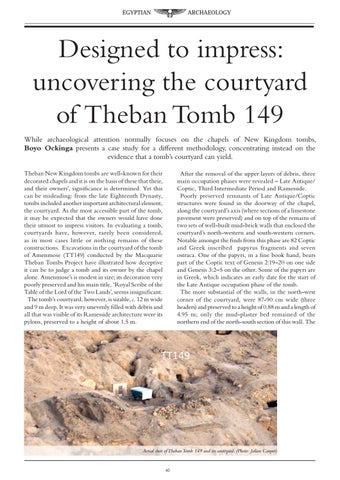
Designed to impress: uncovering the courtyard of Theban Tomb 149 While archaeological attention normally focuses on the chapels of New Kingdom tombs, Boyo Ockinga presents a case study for a different methodology, concentrating instead on the evidence that a tomb’s courtyard can yield. Theban New Kingdom tombs are well-known for their decorated chapels and it is on the basis of these that their, and their owners’, significance is determined. Yet this can be misleading: from the late Eighteenth Dynasty, tombs included another important architectural element, the courtyard. As the most accessible part of the tomb, it may be expected that the owners would have done their utmost to impress visitors. In evaluating a tomb, courtyards have, however, rarely been considered, as in most cases little or nothing remains of these constructions. Excavations in the courtyard of the tomb of Amenmose (TT149) conducted by the Macquarie Theban Tombs Project have illustrated how deceptive it can be to judge a tomb and its owner by the chapel alone. Amenmose’s is modest in size; its decoration very poorly preserved and his main title, ‘Royal Scribe of the Table of the Lord of the Two Lands’, seems insignificant. The tomb’s courtyard, however, is sizable, c. 12 m wide and 9 m deep. It was very unevenly filled with debris and all that was visible of its Ramesside architecture were its pylons, preserved to a height of about 1.5 m.
After the removal of the upper layers of debris, three main occupation phases were revealed – Late Antique/ Coptic, Third Intermediate Period and Ramesside. Poorly preserved remnants of Late Antique/Coptic structures were found in the doorway of the chapel, along the courtyard’s axis (where sections of a limestone pavement were preserved) and on top of the remains of two sets of well-built mud-brick walls that enclosed the courtyard’s north-western and south-western corners. Notable amongst the finds from this phase are 82 Coptic and Greek inscribed papyrus fragments and seven ostraca. One of the papyri, in a fine book hand, bears part of the Coptic text of Genesis 2:19–20 on one side and Genesis 3:2–5 on the other. Some of the papyri are in Greek, which indicates an early date for the start of the Late Antique occupation phase of the tomb. The more substantial of the walls, in the north-west corner of the courtyard, were 87-90 cm wide (three headers) and preserved to a height of 0.88 m and a length of 4.95 m; only the mud-plaster bed remained of the northern end of the north-south section of this wall. The
Aerial shot of Theban Tomb 149 and its courtyard. (Photo: Julien Cooper)
40