EGYPTIAN
ARCHAEOLOGY
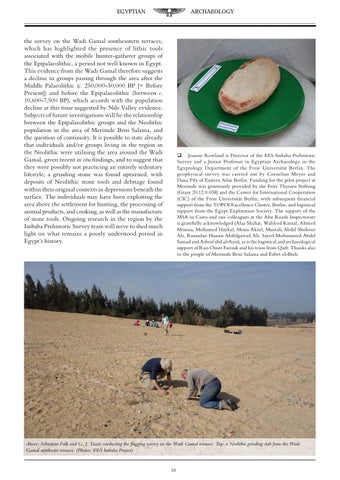
the survey on the Wadi Gamal southeastern terraces, which has highlighted the presence of lithic tools associated with the mobile hunter-gatherer groups of the Epipalaeolithic, a period not well known in Egypt. This evidence from the Wadi Gamal therefore suggests a decline in groups passing through the area after the Middle Palaeolithic (c. 250,000-50,000 BP [= Before Present]) and before the Epipalaeolithic (between c. 10,600-7,500 BP), which accords with the population decline at this time suggested by Nile Valley evidence. Subjects of future investigations will be the relationship between the Epipalaeolithic groups and the Neolithic population in the area of Merimde Beni Salama, and the question of continuity. It is possible to state already that individuals and/or groups living in the region in the Neolithic were utilising the area around the Wadi Gamal, given recent in situ findings, and to suggest that they were possibly not practicing an entirely sedentary lifestyle; a grinding stone was found upturned, with deposits of Neolithic stone tools and debitage found within their original contexts in depressions beneath the surface. The individuals may have been exploiting the area above the settlement for hunting, the processing of animal products, and cooking, as well as the manufacture of stone tools. Ongoing research in the region by the Imbaba Prehistoric Survey team will serve to shed much light on what remains a poorly understood period in Egypt’s history.
Joanne Rowland is Director of the EES Imbaba Prehistoric Survey and a Junior Professor in Egyptian Archaeology in the Egyptology Department of the Freie Universität Berlin. The geophysical survey was carried out by Cornelius Meyer and Dana Pilz of Eastern Atlas Berlin. Funding for the pilot project at Merimde was generously provided by the Fritz Thyssen Stiftung (Grant 20.12.0.058) and the Center for International Cooperation (CIC) of the Freie Universität Berlin, with subsequent financial support from the TOPOI Excellence Cluster, Berlin, and logistical support from the Egypt Exploration Society. The support of the MSA in Cairo and our colleagues at the Abu Roash Inspectorate is gratefully acknowledged (Alaa Shahat, Wahleed Kamal, Ahmed Moussa, Mohamed Haykal, Mona Akml, Mustafa Abdel Shokour Ali, Ramadan Hassan Abdelgawad Ali, Sayed Mohammed Abdel Samad and Ashraf abd al-Aziz), as is the logistical and archaeological support of Rais Omer Farouk and his team from Quft. Thanks also to the people of Merimde Beni Salama and Ezbet el-Biali.
Above: Sebastian Falk and G. J. Tassie conducting the flagging survey on the Wadi Gamal terraces. Top: a Neolithic grinding slab from the Wadi Gamal northwest terraces. (Photos: EES Imbaba Project)
39