EGYPTIAN
ARCHAEOLOGY
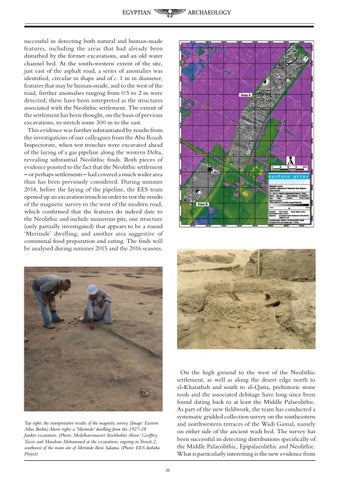
successful in detecting both natural and human-made features, including the areas that had already been disturbed by the former excavations, and an old water channel bed. At the south-western extent of the site, just east of the asphalt road, a series of anomalies was identified, circular in shape and of c. 1 m in diameter, features that may be human-made, and to the west of the road, further anomalies ranging from 0.5 to 2 m were detected; these have been interpreted as the structures associated with the Neolithic settlement. The extent of the settlement has been thought, on the basis of previous excavations, to stretch some 300 m to the east. This evidence was further substantiated by results from the investigations of our colleagues from the Abu Roash Inspectorate, when test trenches were excavated ahead of the laying of a gas pipeline along the western Delta, revealing substantial Neolithic finds. Both pieces of evidence pointed to the fact that the Neolithic settlement – or perhaps settlements – had covered a much wider area than has been previously considered. During summer 2014, before the laying of the pipeline, the EES team opened up an excavation trench in order to test the results of the magnetic survey to the west of the modern road, which confirmed that the features do indeed date to the Neolithic and include numerous pits, one structure (only partially investigated) that appears to be a round ‘Merimde’ dwelling, and another area suggestive of communal food preparation and eating. The finds will be analysed during summer 2015 and the 2016 seasons.
On the high ground to the west of the Neolithic settlement, as well as along the desert edge north to el-Khatatbah and south to el-Qatta, prehistoric stone tools and the associated debitage have long since been found dating back to at least the Middle Palaeolithic. As part of the new fieldwork, the team has conducted a systematic gridded collection survey on the southeastern and northwestern terraces of the Wadi Gamal, namely on either side of the ancient wadi bed. The survey has been successful in detecting distributions specifically of the Middle Palaeolithic, Epipalaeolithic and Neolithic. What is particularly interesting is the new evidence from
Top right: the interpretative results of the magnetic survey. (Image: Eastern Atlas Berlin) Above right: a ‘Merimde’ dwelling from the 1927-28 Junker excavation. (Photo: Medelhavsmuseet Stockholm) Above: Geoffrey Tassie and Mandour Mohammed at the excavations ongoing in Trench 2, southwest of the main site of Merimde Beni Salama. (Photo: EES Imbaba Project) 38