EGYPTIAN
ARCHAEOLOGY
Egypt Exploration Society Expeditions (www.ees.ac.uk)
WINTER 2014-15 Thebes: The EES/Uppsala Univ Theban Harbours and Waterscapes Survey, led by Angus Graham (Univ of Uppsala), focused on further investigations of the West Bank floodplain in Jan-Mar 2015. There were two principal goals: firstly to extend the transect of hand augering and percussion coring started in 2014 in front of the Ramesseum, and secondly to further our understanding of the building and engineering activities of Amenhotep III in the floodplain by continuing our work at his Mansion of Millions of Years and at Birket Habu. We continued our augering and coring transect, together with ERT, eastwards for a total of 3.2 km between the Ramesseum and the W bank of the Nile. The aim was to map the floodplain to identify the existence and location of former branches of the Nile and possible canals. Preliminary results indicate a flood basin between the Ramesses Canal (Tir’at Rameses) and el-Fâdilîya Canal. Between the el-Fâdilîya and the active channel of the Nile the sedimentary record of the channel and island (Gezirat Sa’d) known from early maps was recorded. A series of percussion cores were carried out to the N and E of the Colossi of Memnon together with geophysics (ERT, GPR and magnetometry) in the First Court and in front of the Memnon colossi, revealing potential structures on the central axis of the temple. At Birket Habu we conducted 3D photogrammetry and GPR on the A and B mounds to the W of the birket. The GPR results show the internal structure of the mounds, including mud-brick terracing and infilling of different levels of the mounds, and possible mud-brick paved areas on the low-lying area between the mounds. http:// eestheban.tumblr.com/
SPRING 2015 Tell Mutubis: This season, a small team under Penny Wilson (Durham Univ) worked at Tell Mutubis to undertake a more extensive magnetic susceptibility (magnetometer) survey of areas of the main mound and also of the surrounding flatter areas. The team worked together with Inspectors from the Kafr el-Sheikh office and the Tell Fara’in magazine in studying the methods used at the site, the aims of the research and the skills training in using theodolites and the fluxgate magnetometer. The processing of the results is complicated by the salinity of the outlining areas and the dense red-brick and pottery coverage of the mound, but the work has shown some interesting sub-surface features. In addition, visits to outlying villages and towns were undertaken to add local information to the story of the site. http://www.dur.ac.uk/Penelope.
Wilson/Delta/Mutubis.html
Tell Buweib: Two areas were investigated in a short season by Jeffrey Spencer’s team of the EES Delta Survey in an attempt to refine the dating
Penny Wilson at Tell Mutubis. (Photo: Chris Naunton)
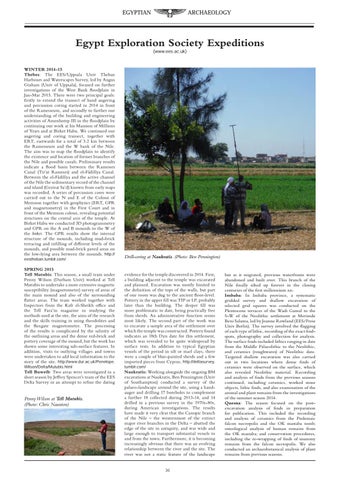
Drill-coring at Naukratis. (Photo: Ben Pennington) evidence for the temple discovered in 2014. First, a building adjacent to the temple was excavated and planned. Excavation was mostly limited to the definition of the tops of the walls, but part of one room was dug to the ancient floor-level. Pottery in the upper fill was TIP or LP, probably later than the building. The deeper fill was more problematic to date, being practically free from sherds. An administrative function seems most likely. The second part of the work was to excavate a sample area of the settlement over which the temple was constructed. Pottery found indicates an 18th Dyn date for this settlement, which was revealed to be quite widespread by surface tests. In addition to typical Egyptian vessels of the period in silt or marl clays, there were a couple of blue-painted sherds and a few imported pieces from Cyprus. http://deltasurvey. tumblr.com/
Naukratis: Working alongside the ongoing BM excavations at Naukratis, Ben Pennington (Univ of Southampton) conducted a survey of the palaeo-landscape around the site, using a handauger and drilling 17 boreholes to complement a further 18 collected during 2013-14, and 14 drilled in a previous survey in the 1970s-80s, during American investigations. The results have made it very clear that the Canopic branch of the Nile – the westernmost of the extinct major river branches in the Delta – abutted the edge of the site in antiquity, and was wide and large enough to transport substantial vessels to and from the town. Furthermore, it is becoming increasingly obvious that there was an evolving relationship between the river and the site. The river was not a static feature of the landscape 36
but as it migrated, previous waterfronts were abandoned and built over. This branch of the Nile finally silted up forever in the closing centuries of the first millennium ad. Imbaba: In Imbaba province, a systematic gridded survey and shallow excavation of selected grid squares was conducted on the Pleistocene terraces of the Wadi Gamal to the S-W of the Neolithic settlement at Merimde Beni Salama, led by Joanne Rowland (EES/Freie Univ Berlin). The survey involved the flagging of each type of lithic, recording of the exact findspots, photography and collection for analysis. The surface finds included lithics ranging in date from the Middle Palaeolithic to the Neolithic, and ceramics (roughwares) of Neolithic date. Targeted shallow excavation was also carried out in two locations where dense finds of ceramics were observed on the surface, which also revealed Neolithic material. Recording and analysis of finds from the previous seasons continued, including ceramics, worked stone objects, lithic finds, and also examination of the animal and plant remains from the investigations of the summer season 2014. Quesna: The season focused on the postexcavation analysis of finds in preparation for publication. This included the recording and analysis of ceramics from the Ptolemaic falcon necropolis and the OK mastaba tomb; osteological analysis of human remains from the OK mastaba; and conservation procedures, including the re-wrapping of finds of mummy remains from the falcon necropolis. We also conducted an archaeobotanical analysis of plant remains from previous seasons.