EGYPTIAN
ARCHAEOLOGY
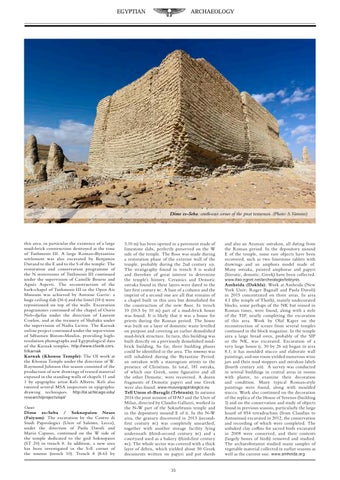
Dime es-Seba: south-east corner of the great temenos. (Photo: S.Vannini)
this area, in particular the existence of a large mud-brick construction destroyed at the time of Tuthmosis III. A large Roman-Byzantine settlement was also excavated by Benjamin Durand to the E and to the S of the temple. The restoration and conservation programme of the N storerooms of Tuthmosis III continued under the supervision of Camille Bourse and Agnès Asperti. The reconstruction of the bark-chapel of Tuthmosis III in the Open Air Museum was achieved by Antoine Garric: a huge ceiling slab (36 t) and the lintel (18 t) were repositioned on top of the walls. Excavation programmes continued of the chapel of Osiris Neb-djefau under the direction of Laurent Coulon, and at the treasury of Shabaka under the supervision of Nadia Licitra. The Karnak online project continued under the supervision of Sébastien Biston-Moulin, providing highresolution photographs and Egyptological data of the Karnak temples. http://www.cfeetk.cnrs. fr/karnak
Karnak (Khonsu Temple): The OI work at the Khonsu Temple under the direction of W. Raymond Johnson this season consisted of the production of new drawings of reused material exposed in the standing walls of chapels 11 and 1 by epigraphic artist Keli Alberts. Keli also tutored several MSA inspectors in epigraphic drawing techniques. http://oi.uchicago.edu/ research/projects/epi/
Oases Dime es-Seba / Soknopaiou Nesos (Faiyum): The excavation by the Centro di Studi Papirologici (Univ of Salento, Lecce), under the direction of Paola Davoli and Mario Capasso, continued on the W side of the temple dedicated to the god Soknopaios (ST 20) in trench 8. In addition, a new area has been investigated in the S-E corner of the temenos (trench 10). Trench 8 (8.65 by
3.10 m) has been opened in a pavement made of limestone slabs, perfectly preserved on the W side of the temple. The floor was made during a restoration phase of the exterior wall of the temple, probably during the 2nd century ad. The stratigraphy found in trench 8 is sealed and therefore of great interest to determine the temple’s history. Ceramics and Demotic ostraka found in these layers were dated to the late first century bc. A base of a column and the imprint of a second one are all that remains of a chapel built in this area but demolished for the construction of the new floor. In trench 10 (10.5 by 10 m) part of a mud-brick house was found. It is likely that it was a house for priests during the Roman period. The house was built on a layer of domestic waste levelled on purpose and covering an earlier demolished mud-brick structure. In turn, this building was built directly on a previously demolished mudbrick building. So far, three building phases could be identified in the area. The temenos was still inhabited during the Byzantine Period: an ostrakon with a staurogram attests to the presence of Christians. In total, 181 ostraka, of which one Greek, some figurative and all the other Demotic, were recovered. A dozen fragments of Demotic papyri and one Greek were also found. www-museopapirologico.eu Tell Umm el-Baragât (Tebtunis): In autumn 2014 the joint mission of IFAO and the Univ of Milan, directed by Claudio Gallazzi, worked in the N-W part of the Soknebtunis temple and in the depository mound E of it. In the N-W area, the granary discovered in 2013 (secondfirst century bc) was completely unearthed, together with another storage facility lying underneath (third-second century bc) and a courtyard used as a bakery (third-first century bc). The whole sector was covered with a thick layer of debris, which yielded about 50 Greek documents written on papyri and pot sherds 35
and also an Aramaic ostrakon, all dating from the Roman period. In the depository mound E of the temple, some rare objects have been recovered, such as two limestone tablets with drawings and an amphora model made of. Many ostraka, painted amphorae and papyri (hieratic, demotic, Greek) have been collected. www.ifao.egnet.net/archeologie/tebtynis
Amheida (Dakhla): Work at Amheida (New York Univ; Roger Bagnall and Paola Davoli) in 2015 concentrated on three areas. In area 4.1 (the temple of Thoth), mainly undecorated blocks, some perhaps of the NK but reused in Roman times, were found, along with a stele of the TIP, nearly completing the excavation of this area. Work by Olaf Kaper on the reconstruction of scenes from several temples continued in the block magazine. In the temple area a large bread oven, probably of the SIP or the NK, was excavated. Excavation of a very large house (c. 30 by 26 m) began in area 8.1; it has moulded stucco and elaborate wall paintings, and one room yielded numerous wine jars and their mud stoppers and ostrakon labels (fourth century ad). A survey was conducted in several buildings in central areas in rooms with plaster, to examine their decoration and condition. Many typical Roman-style paintings were found, along with moulded stucco. Work also continued on the decoration of the replica of the House of Serenos (building 1) and on the conservation and study of objects found in previous seasons, particularly the large hoard of 854 tetradrachms (from Claudius to Antoninus) excavated in 2012, the conservation and recording of which were completed. The unbaked clay coffins for sacred birds excavated in 2008 were conserved, and their contents (largely bones of birds) removed and studied. The archaeobotanist studied many samples of vegetable material collected in earlier seasons as well as the current one. www.amheida.org