EGYPTIAN
ARCHAEOLOGY
box containing the viscera of the deceased. Next to this wooden box we also discovered three vases in fragments, completely reconstructible, dating to the Persian Period. Excavating the small rooms located in the S part of the temple we discovered a pottery ostrakon (33.8 cm long) with a hieratic text traced in black, probably the Instruction of King Amenemhat for his son Sesostris I. The restoration works of the ramp and of the enclosure walls also continued. Western Thebes (Dra Abu el-Naga North): The CSIC mission, led by José M. Galán, continued excavation around the tomb-chapel of Djehuty (TT 11). Above the chapel, the mudbrick façade of the tomb-chapel of Djehutynefer, overseer of the treasure after Djehuty (i.e under Thutmose III), was rediscovered. It was first found by Champollion and Rosellini in 1829, then lost. The entrance of a 13th Dyn rock-cut tomb was also brought to light. A mudbrick offering chapel of the 17th/early 18th Dyn was excavated and also two (robbed) shafts, one of them preserving in good condition two bows and twenty arrows. The study of the hundreds of animal mummies deposited inside the burial chamber of Hery (TT 12) continued, as did the restoration of both neighbouring tomb-chapels. www.excavacionegipto.com
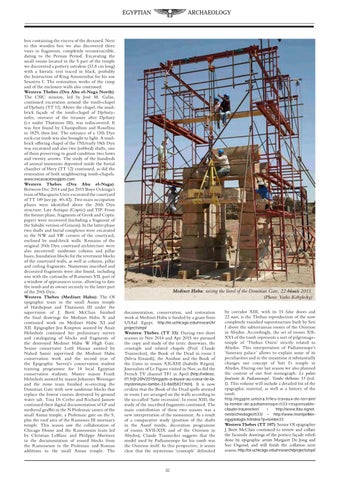
Western Thebes (Dra Abu el-Naga): Between Dec 2014 and Jan 2015 Boyo Ockinga’s team of Macquarie Univ excavated the courtyard of TT 149 (see pp. 40-42). Two main occupation phases were identified above the 20th Dyn structure: Late Antique (Coptic) and TIP. From the former phase, fragments of Greek and Coptic papyri were recovered (including a fragment of the Sahidic version of Genesis). In the latter phase two shafts and burial complexes were excavated in the NW and SW corners of the courtyard, enclosed by mud-brick walls. Remains of the original 20th Dyn courtyard architecture were also uncovered: sandstone column and pillar bases, foundation blocks for the revetment blocks of the courtyard walls, as well as column, pillar and ceiling fragments. Numerous inscribed and decorated fragments were also found, including one with the cartouche of Ramesses VII, part of a window of appearances scene, allowing to date the tomb and its owner securely to the latter part of the 20th Dyn. Western Thebes (Medinet Habu): The OI epigraphic team in the small Amun temple of Hatshepsut and Thutmosis III under the supervision of J. Brett McClain finished the final drawings for Medinet Habu X and continued work on Medinet Habu XI and XII. Epigrapher Jen Kimpton assisted by Anait Helmholz continued her preliminary survey and cataloguing of blocks and fragments of the destroyed Medinet Habu W High Gate. Senior conservator Lotfi Hassan assisted by Nahed Samir supervised the Medinet Habu conservation work and the second year of the Epigraphic Survey’s conservation student training programme for 14 local Egyptian conservation students. Master mason Frank Helmholz assisted by mason Johannes Weninger and the stone team finished re-erecting the Domitian Gate with new sandstone blocks that replace the lowest courses destroyed by ground water salt. Tina Di Cerbo and Richard Jasnow continued their digital documentation of LP and medieval graffiti in the N Ptolemaic annex of the small Amun temple, a Ptolemaic gate on the S, plus the roof area of the Ramesses III mortuary temple. This season saw the collaboration of Chicago House and the Ramesseum team led by Christian LeBlanc and Philippe Martinez in the documentation of reused blocks from the Ramesseum in the Ptolemaic and Roman additions to the small Amun temple. The
Medinet Habu: raising the lintel of the Domitian Gate, 22 March 2015. (Photo: Yarko Kobylecky) documentation, conservation, and restoration work at Medinet Habu is funded by a grant from USAid Egypt. http://oi.uchicago.edu/research/ projects/epi/
Western Thebes (TT 33): During two short seasons in Nov 2014 and Apr 2015 we pursued the copy and study of the texts: doorways, the cenotaph and related chapels (Prof. Claude Traunecker), the Book of the Dead in room I (Silvia Einaudi), the Amduat and the Book of the Gates in rooms XII-XIII (Isabelle Régen). Journalists of Le Figaro visited in Nov, as did the French TV channel TF1 in April (http://videos.
tf1.fr/jt-20h/2015/egypte-a-louxor-au-coeur-de-lamysterieuse-tombe-33-8605837.htm). It is now
evident that the Book of the Dead spells attested in room I are arranged on the walls according to the so-called ‘Saite recension’. In room XIII, the study of the inscribed fragments continued. The main contribution of these two seasons was a new interpretation of the monument. As a result of a comparative study (position of the shafts in the Asasif tombs, decoration programme of rooms XVII-XIX and of the Osireion in Abydos), Claude Traunecker suggests that the model used by Padiamenope for his tomb was the Osireion itself. In this perspective, it seems clear that the mysterious ‘cenotaph’ delimited
32
by corridor XIII, with its 15 false doors and 22 naoi, is the Theban reproduction of the now completely vanished superstructure built by Seti I above the subterranean rooms of the Osireion in Abydos. Accordingly, the set of rooms XIIXVI of the tomb represents a sort of pilgrimagetemple of ‘Theban Osiris’ strictly related to Abydos. This interpretation of Padiamenope’s ‘funerary palace’ allows to explain some of its peculiarities and in the meantime it substantially changes our concept of Seti I’s temple in Abydos. During our last season we also planned the content of our first monograph: Le palais funéraire de Padiamenopé. Tombe thébaine 33 (vol. I). This volume will include a detailed list of the epigraphic material, as well as a history of the tomb. http://egypte.unistra.fr/les-travaux-de-terrain/ la-tombe-de-padiamenope-tt33 -responsableclaude-traunecker/ • http://www.ifao.egnet. net/archeologie/tt33/ • http://www.montpellieregyptologie.fr/index?p=tombe33
Western Thebes (TT 107): Senior OI epigrapher J. Brett McClain continued to review and collate the facsimile drawings of the portico façade reliefs done by epigraphic artists Margaret De Jong and Sue Osgood, and will finish the collation next season. http://oi.uchicago.edu/research/projects/epi/