EGYPTIAN
ARCHAEOLOGY
Digging Diary 2014-15 Summaries of some of the archaeological work undertaken in Egypt between autumn 2014 and summer 2015. The sites are arranged geographically from north to south, ending with the oases. Field Directors who would like reports of their work to appear in EA are asked to e-mail a short summary, with a website address if available, as soon as possible after the end of each season to: jan.geisbusch@ees.ac.uk
Jan Geisbusch
Abbreviations: EDP Early Dynastic Period; OK Old Kingdom; FIP First Intermediate Period; MK Middle Kingdom; SIP Second Intermediate Period; NK New Kingdom; TIP Third Intermediate Period; LP Late Period; GR Graeco-Roman; ERT Electrical Resistance Tomography; GPR Ground Penetrating Radar Institutes and Research Centres: AKAP Aswan-Kom Ombo Archaeological Project; ARCE American Research Center in Egypt; AUC American University, Cairo; BA British Academy; BM British Museum; CFEETK Franco-Egyptian Centre, Karnak; CNRS (USR) French National Research Centre (Research Groups); CSIC Spanish National Research Council; DAI German Archaeological Institute, Cairo; FNRS National Fund for Scientific Research, Brussels; IFAO French Archaeological Institute, Cairo; MSA Ministry of State for Antiquities, Egypt; NVIC NetherlandsFlemish Institute, Cairo; OI Oriental Institute, University of Chicago; PCMA Polish Centre for Mediterranean Archaeology, Warsaw; Swiss Inst Swiss Institute for Architectural Research and Archaeology, Cairo;. WINTER 2014-15 (November to February) Lower Egypt Tell el-Farkha (Ghazala): The mission under Marek Chlodnicki and Krzysztof Cialowicz of the Inst of Archaeology Jagiellonian Univ, KrakÓw, the Poznan Archaeological Museum and the PCMA worked at a number of sites: at the W kom, excavations were made in strata dated to Naqada IIIA-IID. The most important work concentrated on the brewery discovered two years ago, showing three phases of use. A cross-section was established and a part of the brewery explored. At the central kom the team explored an earlier phase of the large rectangular building (probably a central storeroom) dating to Naqada IIIA1 and discovered in 2012. Underneath, a mud-brick wall was found belonging to the so-called ‘Lower Egyptian Residence’ (Naqada IIC/D) – a continuation of the wall discovered in 2007 in the neighbouring trench. The rounded building on the N-W slope of the kom, built in the middle of the 1st Dyn, could be explored in its entirety. At the E kom 13 graves were discovered. Most of them (dated to the later half of the 1st Dyn and the beginning of the 2nd) were very poor. Four graves were furnished more richly. The oldest grave (dated to Naqada IIIB) was furnished with stone and clay vessels, a cosmetic palette and a necklace of carnelian and lapis-lazuli beads. www.farkha.org Qarara: After two years’ interruption, the Inst of Egyptology (Univ Tübingen) under the fielddirectorship of Beatrice Huber has devoted a brief season in November 2014 to a small settlement lying 100 m E of the Coptic site. It is situated on an area of 100 by 100 m, 20 m higher than the main site. The settlement is seriously threatened by the advance of the modern Muslim cemetery, so it was necessary to record the area before its complete destruction. The area is covered by a thick layer of bricks and pottery, particularly amphorae LRA7. Building walls are preserved only to the height of a few brick layers. They
belong to domestic installations with ovens and silos. About 20 tombs of male and female individuals have been recorded superficially. The main textiles collected are tunics of Roman type which can be dated to the 4th-5th century. Under the buildings five tombs were found without grave goods. Funeral wrappings differed from those of the Coptic burials. Until now, it has not been possible to define the exact function of this settlement including a cemetery, which is situated in the immediate vicinity of the main site. El-Kom el-Ahmar (Sharuna): The work under the auspices of the Inst of Egyptology (Univ Tübingen), directed by Beatrice Huber, continued the excavation begun in 2010/2012 in the N-W side of the rock necropolis (directed by Luis Gonzálves, Museu Egipci de Barcelona), completing research in the OK tomb L8a, reused in Ptolemaic times, where the two inner chambers have been recorded. Next to them, the robbed and scattered remains of more than 50 individuals were found with a batch of amulets, a lot of pottery and offering tables. E of L8a, excavations have begun in the OK tomb ensemble M9, which consists of a big courtyard and a chamber with a false door and a funerary shaft. The tomb had been reoccupied in the Ptolemaic period. The area in front of the tombs has been used as a Coptic cemetery. Seven graves have been discovered until now; they are dug in the rock and sometimes cut into earlier tomb structures. The bodies are undisturbed; they are wrapped in typical Coptic fashion. http://www.uni-tuebingen.de/fakultaeten/
philosophische-fakultaet/fachbereiche/altertumsund - kunst wis sensc haf ten / ianes / for sc hung / aegyptologie/projekte.html
Upper Egypt Athribis: The Athribis Project of the Univ Tübingen and the MSA, led by Christian Leitz and Abdelhakim Qarar and directed in the field by Marcus Müller, continued its work in the Repit temple of Ptolemy XII. During the 13th season (Nov 2014-Mar 2015) several rooms were excavated, all but one revealing reliefs
and inscriptions, many of them colourful. The excavation of the E ambulatory was finished, the floor being disrupted by a Coptic water conduit. Its columns now show coloured reliefs and inscriptions. The N ambulatory revealed a massive robbery of temple blocks down to the sixth foundation layer. Along the W wall of the temple we discovered elaborate Roman mudbrick structures such as a workshop and animal shelters with feeding sites. All rooms contained finds of daily life dating post 642 ad (Islamic conquest) when the temple was used for domestic purposes and as animal shelter. Epigraphic work focused on collating numerous texts in various rooms and the recording of newly discovered texts. Fifty-seven collapsed blocks were removed from the temple which is now void of big blocks. Consolidation and restoration were undertaken at numerous spots throughout the temple, on collapsed blocks and single finds, mainly on polychrome reliefs. http://www.unituebingen.de/aktuelles/pressemitteilungen/200912-05akademieprojekt-english.html
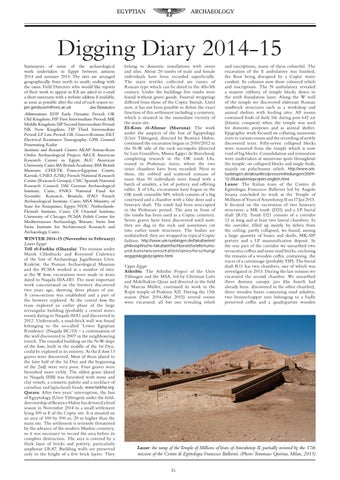
Luxor: The Italian team of the Centro di Egittologia Francesco Ballerini led by Angelo Sesana concluded its work at the Temple of Millions of Years of Amenhotep II on 17 Jan 2015. It focused on the excavation of two funerary structures: a MK tomb (D21) and a LP burial shaft (R11). Tomb D21 consists of a corridor 12 m long and at least two lateral chambers. In the corridor, filled up mostly by debris from the ceiling, partly collapsed, we found, among a large quantity of bones and skulls, MK-SIP pottery and a LP mummification deposit. In the rear part of the corridor we unearthed two terracotta coffins and some mud bricks, enclosing the remains of a wooden coffin, containing the traces of a cartonnage (probably TIP). The burial shaft R11 has two chambers, one of which was investigated in 2013. During the last mission we excavated the second chamber. We unearthed three dummy canopic jars (the fourth had already been discovered in the other chamber), three wooden boxes containing mud ushabtis, two bronze/copper eyes belonging to a badly preserved coffin and a quadripartite wooden
Luxor: the ramp of the Temple of Millions of Years of Amenhotep II, partially restored by the 17th mission of the Centro di Egittologia Francesco Ballerini. (Photo:Tommaso Quirino, Milan, 2015) 31