EGYPTIAN
ARCHAEOLOGY
At least ten pieces that belong to ivory magical wands as well as one complete specimen (Inv. no. 15323), decorated with protective symbols related to birth and rebirth. Although their state of preservation varies, it is possible to identify turtles, crocodiles, serpents, felines and other animals. Two incomplete female heads display lateral locks of hair on each side and another lock on the back of the head (Inv. nos 15178 and 15262). These statuettes were crafted from limestone and very likely represent fertility figures which were deposited in tombs. There were also numerous wooden fragments belonging to staffs and the model of a boat, most of which were badly preserved; some cedar wood oars and rudders (Inv. no. 15151); pieces of statuettes as well as scarabs, small plates and ornaments that once were parts of pendants. In 2014, the team continued work in the necropolis beneath the temple and discovered three additional tombs. One of them, tomb XIV, excavated by Ismael MacĂas, is located under the south sector of the hypostyle hall. As its funerary chamber had partially collapsed, it had remained unlooted. The tomb consisted of a rectangular burial shaft 5.15 m deep, at the bottom of which there were two chambers: the main chamber was oriented towards the east, with two niches oriented north and southwest respectively, in which the coffins were deposited. Chamber 2 was oriented towards the west. The coffin niches had further, smaller recesses, probably for the canopic jars. After the gradual clearing of the collapsed section around the tomb, we found a wooden coffin in the southwestern niche, containing the mummy of a woman. Both sarcophagus and mummy had been badly damaged by the collapse, though the jewellery found with the body remained intact. A complete female body still undisturbed in situ, the body laid out in a west-east direction, was discovered within the coffin. It was not possible to determine which direction the head had been facing, as fallen masonry
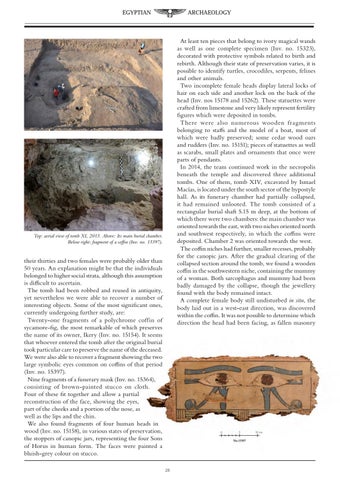
Top: aerial view of tomb XI, 2013. Above: Its main burial chamber. Below right: fragment of a coffin (Inv. no. 15397).
their thirties and two females were probably older than 50 years. An explanation might be that the individuals belonged to higher social strata, although this assumption is difficult to ascertain. The tomb had been robbed and reused in antiquity, yet nevertheless we were able to recover a number of interesting objects. Some of the most significant ones, currently undergoing further study, are: Twenty-one fragments of a polychrome coffin of sycamore-fig, the most remarkable of which preserves the name of its owner, Ikery (Inv. no. 15154). It seems that whoever entered the tomb after the original burial took particular care to preserve the name of the deceased. We were also able to recover a fragment showing the two large symbolic eyes common on coffins of that period (Inv. no. 15397). Nine fragments of a funerary mask (Inv. no. 15364), consisting of brown-painted stucco on cloth. Four of these fit together and allow a partial reconstruction of the face, showing the eyes, part of the cheeks and a portion of the nose, as well as the lips and the chin. We also found fragments of four human heads in wood (Inv. no. 15158), in various states of preservation, the stoppers of canopic jars, representing the four Sons of Horus in human form. The faces were painted a bluish-grey colour on stucco. 28