EGYPTIAN
ARCHAEOLOGY
EGYPTIAN ARCHAEOLOGY Bulletin of the Egypt Exploration Society www.ees.ac.uk The opinions expressed do not necessarily reflect the aims or concerns of the Egypt Exploration Society Editor Jan Geisbusch Editorial Advisers Aidan Dodson John J Johnston Caitlin McCall Chris Naunton Luigi Prada Alice Stevenson John Taylor Advertising Sales Egypt Exploration Society 3 Doughty Mews London WC1N 2PG Phone: +44 (0)20 7242 1880 Fax: +44 (0)20 7404 6118 E-mail: jan.geisbusch@ees.ac.uk Distribution Phone: +44 (0)20 7242 2268 E-mail: orders@ees.ac.uk Website: www.ees-shop.co.uk
Published twice a year by The Egypt Exploration Society 3 Doughty Mews, London WC1N 2PG Registered Charity, No. 212384 A Limited Company registered in England, No. 25816 Original design by Jeremy Pemberton Set in InDesign CS6 by Jan Geisbusch Printed by Page Bros Ltd, Mile Cross Lane, Norwich, Norfolk NR6 6SA Š The Egypt Exploration Society and the contributors. No part of this publication may be reproduced without prior permission of the publishers.
ISSN 0962 2837
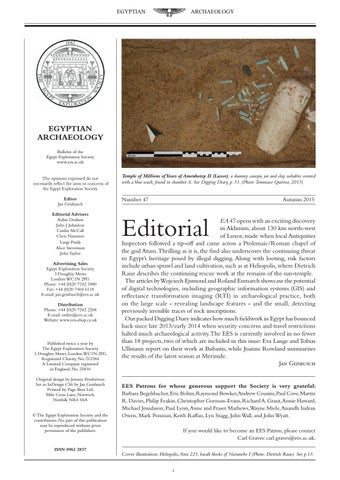
Temple of Millions of Years of Amenhotep II (Luxor): a dummy canopic jar and clay ushabtis covered with a blue wash, found in chamber A. See Digging Diary, p. 31. (Photo:Tommaso Quirino, 2015)
Number 47
Autumn 2015
Editorial
EA 47 opens with an exciting discovery in Akhmim, about 130 km north-west of Luxor, made when local Antiquities Inspectors followed a tip-off and came across a Ptolemaic/Roman chapel of the god Atum. Thrilling as it is, the find also underscores the continuing threat to Egypt’s heritage posed by illegal digging. Along with looting, risk factors include urban sprawl and land cultivation, such as at Heliopolis, where Dietrich Raue describes the continuing rescue work at the remains of the sun-temple. The articles by Wojciech Ejsmond and Roland Enmarch showcase the potential of digital technologies, including geographic information systems (GIS) and reflectance transformation imaging (RTI) in archaeological practice, both on the large scale - revealing landscape features - and the small, detecting previously invisible traces of rock inscriptions. Our packed Digging Diary indicates how much fieldwork in Egypt has bounced back since late 2013/early 2014 when security concerns and travel restrictions halted much archaeological activity. The EES is currently involved in no fewer than 18 projects, two of which are included in this issue: Eva Lange and Tobias Ullmann report on their work at Bubastis, while Joanne Rowland summarises the results of the latest season at Merimde. Jan Geisbusch
EES Patrons for whose generous support the Society is very grateful: Barbara Begelsbacher, Eric Bohm, Raymond Bowker,Andrew Cousins, Paul Cove, Martin R. Davies, Philip Feakin, Christopher Gorman-Evans, Richard A. Grant,Annie Haward, Michael Jesudason, Paul Lynn, Anne and Fraser Mathews,Wayne Miele, Anandh Indran Owen, Mark Ponman, Keith Raffan, Lyn Stagg, John Wall, and John Wyatt. If you would like to become an EES Patron, please contact Carl Graves: carl.graves@ees.ac.uk. Cover illustration: Heliopolis, Area 221, basalt blocks of Nectanebo I (Photo: Dietrich Raue). See p.13. 1