EGYPTIAN
ARCHAEOLOGY
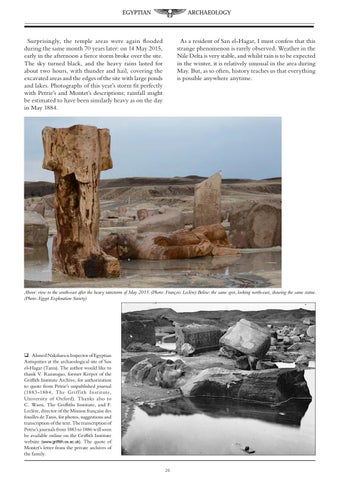
Surprisingly, the temple areas were again flooded during the same month 70 years later: on 14 May 2015, early in the afternoon a fierce storm broke over the site. The sky turned black, and the heavy rains lasted for about two hours, with thunder and hail, covering the excavated areas and the edges of the site with large ponds and lakes. Photographs of this year’s storm fit perfectly with Petrie’s and Montet’s descriptions; rainfall might be estimated to have been similarly heavy as on the day in May 1884.
As a resident of San el-Hagar, I must confess that this strange phenomenon is rarely observed. Weather in the Nile Delta is very stable, and whilst rain is to be expected in the winter, it is relatively unusual in the area during May. But, as so often, history teaches us that everything is possible anywhere anytime.
Above: view to the south-east after the heavy rainstorm of May 2015. (Photo: François Leclère) Below: the same spot, looking north-east, showing the same statue. (Photo: Egypt Exploration Society)
Ahmed Nakshara is Inspector of Egyptian Antiquities at the archaeological site of San el-Hagar (Tanis). The author would like to thank V. Razanajao, former Keeper of the Griffith Institute Archive, for authorization to quote from Petrie’s unpublished journal (1883 -1884, The Gr if f ith Inst it ute, University of Oxford). Thanks also to C. Warsi, The Griffiths Institute, and F. Leclère, director of the Mission française des fouilles de Tanis, for photos, suggestions and transcription of the text. The transcription of Petrie’s journals from 1883 to 1886 will soon be available online on the Griffith Institute website (www.griffith.ox.ac.uk). The quote of Montet’s letter from the private archives of the family. 26