EGYPTIAN
ARCHAEOLOGY
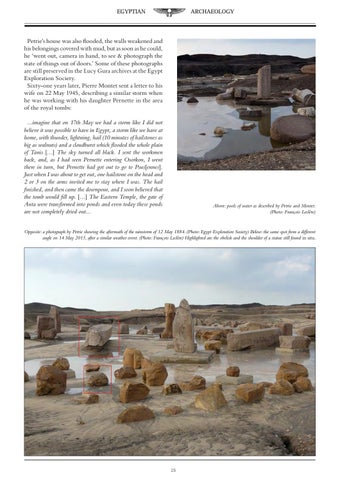
Petrie’s house was also flooded, the walls weakened and his belongings covered with mud, but as soon as he could, he ‘went out, camera in hand, to see & photograph the state of things out of doors.’ Some of these photographs are still preserved in the Lucy Gura archives at the Egypt Exploration Society. Sixty-one years later, Pierre Montet sent a letter to his wife on 22 May 1945, describing a similar storm when he was working with his daughter Pernette in the area of the royal tombs: ...imagine that on 17th May we had a storm like I did not believe it was possible to have in Egypt, a storm like we have at home, with thunder, lightning, hail (10 minutes of hailstones as big as walnuts) and a cloudburst which flooded the whole plain of Tanis […] The sky turned all black. I sent the workmen back, and, as I had seen Pernette entering Osorkon, I went there in turn, but Pernette had got out to go to Psus[ennes]. Just when I was about to get out, one hailstone on the head and 2 or 3 on the arms invited me to stay where I was. The hail finished, and then came the downpour, and I soon believed that the tomb would fill up. […] The Eastern Temple, the gate of Anta were transformed into ponds and even today these ponds are not completely dried out...
Above: pools of water as described by Petrie and Montet. (Photo: François Leclère)
Opposite: a photograph by Petrie showing the aftermath of the rainstorm of 12 May 1884. (Photo: Egypt Exploration Society) Below: the same spot from a different angle on 14 May 2015, after a similar weather event. (Photo: François Leclère) Highlighted are the obelisk and the shoulder of a statue still found in situ.
25