EGYPTIAN
ARCHAEOLOGY
Tanis: rains and ruins Ahmed Nakshara reports on a recent unusual weather event at Tanis that struck the site virtually on the anniversary of similar events reported by Flinders Petrie in 1884 and Pierre Montet in 1945. We have just past [sic] the worst of an awful storm. It thundered almost continuously, & rained & hailed heavily. I was woken from my noon nap at 1.15 by the hail & rain, & now at 2.40 it is not yet over. The hail was so thick that at one time I estimated that half the ground was covered by it, large stones 3/10 & 4/10 inch diameter [...].
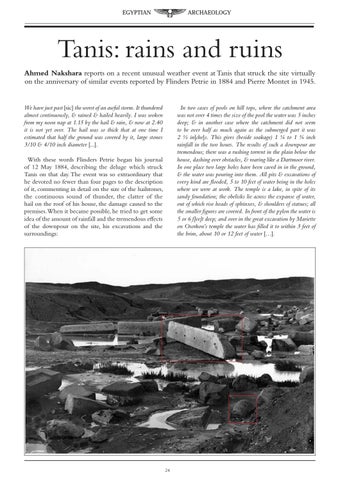
In two cases of pools on hill tops, where the catchment area was not over 4 times the size of the pool the water was 5 inches deep; & in another case where the catchment did not seem to be over half as much again as the submerged part it was 2 ½ in[che]s. This gives (beside soakage) 1 ¼ to 1 ¾ inch rainfall in the two hours. The results of such a downpour are tremendous; there was a rushing torrent in the plain below the house, dashing over obstacles, & roaring like a Dartmoor river. In one place two large holes have been caved in in the ground, & the water was pouring into them. All pits & excavations of every kind are flooded, 5 to 10 feet of water being in the holes where we were at work. The temple is a lake, in spite of its sandy foundation; the obelisks lie across the expanse of water, out of which rise heads of sphinxes, & shoulders of statues; all the smaller figures are covered. In front of the pylon the water is 5 or 6 f[ee]t deep; and over in the great excavation by Mariette on Osorkon’s temple the water has filled it to within 3 feet of the brim, about 10 or 12 feet of water […].
With these words Flinders Petrie began his journal of 12 May 1884, describing the deluge which struck Tanis on that day. The event was so extraordinary that he devoted no fewer than four pages to the description of it, commenting in detail on the size of the hailstones, the continuous sound of thunder, the clatter of the hail on the roof of his house, the damage caused to the premises. When it became possible, he tried to get some idea of the amount of rainfall and the tremendous effects of the downpour on the site, his excavations and the surroundings:
24