EGYPTIAN
ARCHAEOLOGY
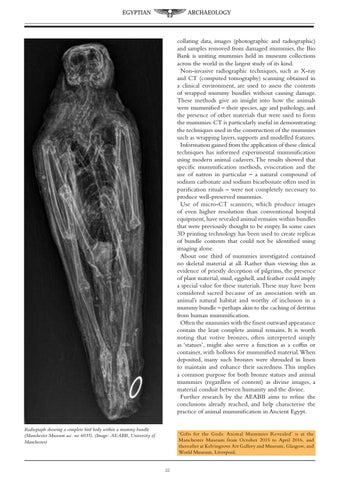
collating data, images (photographic and radiographic) and samples removed from damaged mummies, the Bio Bank is uniting mummies held in museum collections across the world in the largest study of its kind. Non-invasive radiographic techniques, such as X-ray and CT (computed tomography) scanning obtained in a clinical environment, are used to assess the contents of wrapped mummy bundles without causing damage. These methods give an insight into how the animals were mummified – their species, age and pathology, and the presence of other materials that were used to form the mummies. CT is particularly useful in demonstrating the techniques used in the construction of the mummies such as wrapping layers, supports and modelled features. Information gained from the application of these clinical techniques has informed experimental mummification using modern animal cadavers. The results showed that specific mummification methods, evisceration and the use of natron in particular – a natural compound of sodium carbonate and sodium bicarbonate often used in purification rituals – were not completely necessary to produce well-preserved mummies. Use of micro-CT scanners, which produce images of even higher resolution than conventional hospital equipment, have revealed animal remains within bundles that were previously thought to be empty. In some cases 3D printing technology has been used to create replicas of bundle contents that could not be identified using imaging alone. About one third of mummies investigated contained no skeletal material at all. Rather than viewing this as evidence of priestly deception of pilgrims, the presence of plant material, mud, eggshell, and feather could imply a special value for these materials. These may have been considered sacred because of an association with an animal’s natural habitat and worthy of inclusion in a mummy bundle – perhaps akin to the caching of detritus from human mummification. Often the mummies with the finest outward appearance contain the least complete animal remains. It is worth noting that votive bronzes, often interpreted simply as ‘statues’, might also serve a function as a coffin or container, with hollows for mummified material. When deposited, many such bronzes were shrouded in linen to maintain and enhance their sacredness. This implies a common purpose for both bronze statues and animal mummies (regardless of content) as divine images, a material conduit between humanity and the divine. Further research by the AEABB aims to refine the conclusions already reached, and help characterise the practice of animal mummification in Ancient Egypt. Radiograph showing a complete bird body within a mummy bundle (Manchester Museum acc. no 6035). (Image: AEABB, University of Manchester)
‘Gifts for the Gods: Animal Mummies Revealed’ is at the Manchester Museum from October 2015 to April 2016, and thereafter at Kelvingrove Art Gallery and Museum, Glasgow, and World Museum, Liverpool. 22