EGYPTIAN
ARCHAEOLOGY
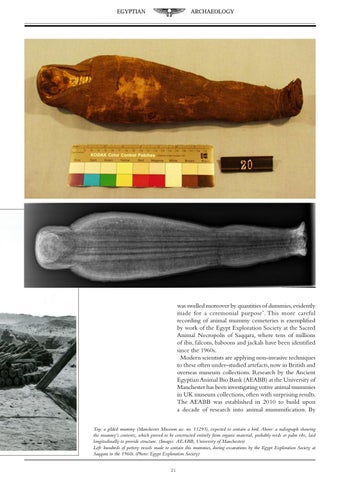
was swelled moreover by quantities of dummies, evidently made for a ceremonial purpose’. This more careful recording of animal mummy cemeteries is exemplified by work of the Egypt Exploration Society at the Sacred Animal Necropolis of Saqqara, where tens of millions of ibis, falcons, baboons and jackals have been identified since the 1960s. Modern scientists are applying non-invasive techniques to these often under-studied artefacts, now in British and overseas museum collections. Research by the Ancient Egyptian Animal Bio Bank (AEABB) at the University of Manchester has been investigating votive animal mummies in UK museum collections, often with surprising results. The AEABB was established in 2010 to build upon a decade of research into animal mummification. By Top: a gilded mummy (Manchester Museum acc. no. 11293), expected to contain a bird. Above: a radiograph showing the mummy’s contents, which proved to be constructed entirely from organic material, probably reeds or palm ribs, laid longitudinally to provide structure. (Images: AEABB, University of Manchester) Left: hundreds of pottery vessels made to contain ibis mummies, during excavations by the Egypt Exploration Society at Saqqara in the 1960s. (Photo: Egypt Exploration Society) 21