EGYPTIAN
ARCHAEOLOGY
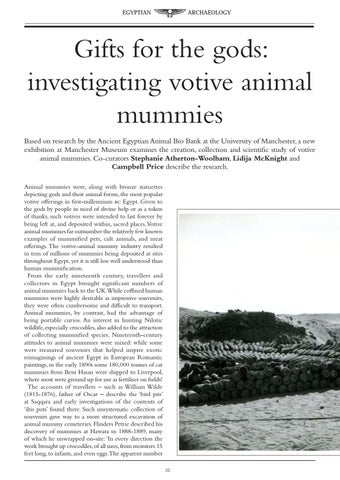
Gifts for the gods: investigating votive animal mummies Based on research by the Ancient Egyptian Animal Bio Bank at the University of Manchester, a new exhibition at Manchester Museum examines the creation, collection and scientific study of votive animal mummies. Co-curators Stephanie Atherton-Woolham, Lidija McKnight and Campbell Price describe the research. Animal mummies were, along with bronze statuettes depicting gods and their animal forms, the most popular votive offerings in first-millennium bc Egypt. Given to the gods by people in need of divine help or as a token of thanks, such votives were intended to last forever by being left at, and deposited within, sacred places. Votive animal mummies far outnumber the relatively few known examples of mummified pets, cult animals, and meat offerings. The votive-animal mummy industry resulted in tens of millions of mummies being deposited at sites throughout Egypt, yet it is still less well understood than human mummification. From the early nineteenth century, travellers and collectors in Egypt brought significant numbers of animal mummies back to the UK.While coffined human mummies were highly desirable as impressive souvenirs, they were often cumbersome and difficult to transport. Animal mummies, by contrast, had the advantage of being portable curios. An interest in hunting Nilotic wildlife, especially crocodiles, also added to the attraction of collecting mummified species. Nineteenth-century attitudes to animal mummies were mixed: while some were treasured souvenirs that helped inspire exotic reimaginings of ancient Egypt in European Romantic paintings, in the early 1890s some 180,000 tonnes of cat mummies from Beni Hasan were shipped to Liverpool, where most were ground up for use as fertiliser on fields! The accounts of travellers – such as William Wilde (1815-1876), father of Oscar – describe the ‘bird pits’ at Saqqara and early investigations of the contents of ‘ibis pots’ found there. Such unsystematic collection of souvenirs gave way to a more structured excavation of animal mummy cemeteries. Flinders Petrie described his discovery of mummies at Hawara in 1888-1889, many of which he unwrapped on-site: ‘In every direction the work brought up crocodiles, of all sizes, from monsters 15 feet long, to infants, and even eggs.The apparent number 20