EGYPTIAN
ARCHAEOLOGY
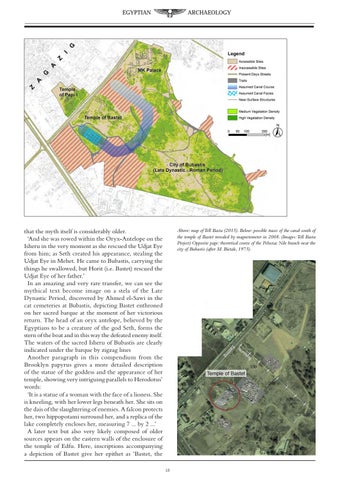
Above: map of Tell Basta (2015). Below: possible traces of the canal south of the temple of Bastet revealed by magnetometer in 2008. (Images: Tell Basta Project) Opposite page: theoretical course of the Pelusiac Nile branch near the city of Bubastis (after M. Bietak, 1975).
that the myth itself is considerably older. ‘And she was rowed within the Oryx-Antelope on the Isheru in the very moment as she rescued the Udjat Eye from him; as Seth created his appearance, stealing the Udjat Eye in Mehet. He came to Bubastis, carrying the things he swallowed, but Horit (i.e. Bastet) rescued the Udjat Eye of her father.’ In an amazing and very rare transfer, we can see the mythical text become image on a stela of the Late Dynastic Period, discovered by Ahmed el-Sawi in the cat cemeteries at Bubastis, depicting Bastet enthroned on her sacred barque at the moment of her victorious return. The head of an oryx antelope, believed by the Egyptians to be a creature of the god Seth, forms the stern of the boat and in this way the defeated enemy itself. The waters of the sacred Isheru of Bubastis are clearly indicated under the barque by zigzag lines Another paragraph in this compendium from the Brooklyn papyrus gives a more detailed description of the statue of the goddess and the appearance of her temple, showing very intriguing parallels to Herodotus’ words: ‘It is a statue of a woman with the face of a lioness. She is kneeling, with her lower legs beneath her. She sits on the dais of the slaughtering of enemies. A falcon protects her, two hippopotami surround her, and a replica of the lake completely encloses her, measuring 7 ... by 2 ...’ A later text but also very likely composed of older sources appears on the eastern walls of the enclosure of the temple of Edfu. Here, inscriptions accompanying a depiction of Bastet give her epithet as ‘Bastet, the
Temple of Bastet
18