EGYPTIAN
ARCHAEOLOGY
Goddess on the water: the sacred landscape of Bubastis Combining archaeological evidence with written records, Eva Lange and Tobias Ullmann, working at Tell Basta (Bubastis), show how geophysical methods can be used to reconstruct the sacred canals once surrounding the famous temple of the cat goddess. The famous temple of Bastet at Bubastis was described in the fifth century bc by the Greek historian Herodotus in quite some detail. He especially mentioned two canals about 30 m wide, sourcing from the Pelusiac Nile branch and surrounding the temple in a way that gave the ancient observer the impression the whole building was set ‘on an island’. The reliability of Herodotus’ descriptions of ancient Egypt is controversial and there may be no overall agreement on how much of his writings is based on fact and how much on fiction. In the case of Bubastis, new archaeological and geophysical research shows that his accounts of the town have to be considered as corresponding closely to the ancient reality.
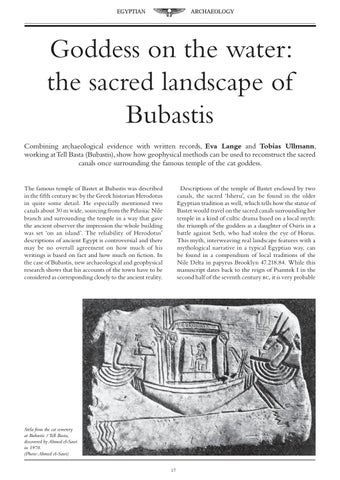
Descriptions of the temple of Bastet enclosed by two canals, the sacred ‘Isheru’, can be found in the older Egyptian tradition as well, which tells how the statue of Bastet would travel on the sacred canals surrounding her temple in a kind of cultic drama based on a local myth: the triumph of the goddess as a daughter of Osiris in a battle against Seth, who had stolen the eye of Horus. This myth, interweaving real landscape features with a mythological narrative in a typical Egyptian way, can be found in a compendium of local traditions of the Nile Delta in papyrus Brooklyn 47.218.84. While this manuscript dates back to the reign of Psamtek I in the second half of the seventh century bc, it is very probable
Stela from the cat cemetery at Bubastis / Tell Basta, discovered by Ahmed el-Sawi in 1970. (Photo: Ahmed el-Sawi) 17