EGYPTIAN
ARCHAEOLOGY
reliefs of Nectanebo. It can be attributed to an undated sphinx of about double life-size. Such statues may have been rearranged within the sanctuaries of the later first millennium bc. The forthcoming season will be mainly devoted to the excavation of the neighbouring squares. Current support by various institutions, foundations and donors, such as the American Research Center in Egypt, will offer one of the final chances to gain first-hand information of a sanctuary from the heart of the sun cult at Heliopolis.
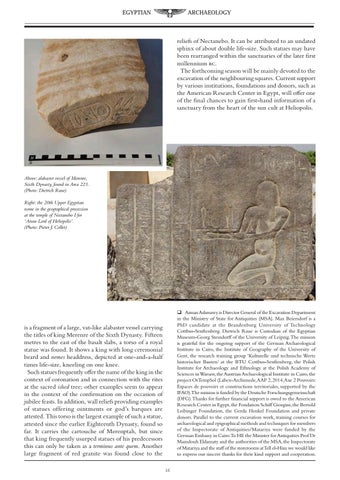
Above: alabaster vessel of Merenre, Sixth Dynasty, found in Area 221. (Photo: Dietrich Raue) Right: the 20th Upper Egyptian nome in the geographical procession at the temple of Nectanebo I for ‘Atum Lord of Heliopolis’. (Photo: Pieter J. Collet)
Aiman Ashmawy is Director General of the Excavation Department in the Ministry of State for Antiquities (MSA). Max Beiersdorf is a PhD candidate at the Brandenburg University of Technology Cottbus-Senftenberg. Dietrich Raue is Custodian of the Egyptian Museum-Georg Steindorff of the University of Leipzig. The mission is grateful for the ongoing support of the German Archaeological Institute in Cairo, the Institute of Geography of the University of Gent, the research training group ‘Kulturelle und technische Werte historischer Bauten’ at the BTU Cottbus-Senftenberg, the Polish Institute for Archaeology and Ethnology at the Polish Academy of Sciences in Warsaw, the Austrian Archaeological Institute in Cairo, the project OrTempSol (Labex-Archimede, AAP 2, 2014, Axe 2 Pouvoirs: Espaces de pouvoirs et constructions territoriales, supported by the IFAO).The mission is funded by the Deutsche Forschungsgemeinschaft (DFG). Thanks for further financial support is owed to the American Research Center in Egypt, the Fondation Schiff Giorgini, the Bertold Leibinger Foundation, the Gerda Henkel Foundation and private donors. Parallel to the current excavation work, training courses for archaeological and epigraphical methods and techniques for members of the Inspectorate of Antiquities/Matariya were funded by the German Embassy in Cairo.To HE the Minister for Antiquities Prof Dr Mamdouh Eldamaty and the authorities of the MSA, the Inspectorate of Matariya and the staff of the storerooms at Tell el-Hisn we would like to express our sincere thanks for their kind support and cooperation.
is a fragment of a large, vat-like alabaster vessel carrying the titles of king Merenre of the Sixth Dynasty. Fifteen metres to the east of the basalt slabs, a torso of a royal statue was found. It shows a king with long ceremonial beard and nemes headdress, depicted at one-and-a-half times life-size, kneeling on one knee. Such statues frequently offer the name of the king in the context of coronation and in connection with the rites at the sacred ished tree; other examples seem to appear in the context of the confirmation on the occasion of jubilee feasts. In addition, wall reliefs providing examples of statues offering ointments or god’s barques are attested. This torso is the largest example of such a statue, attested since the earlier Eighteenth Dynasty, found so far. It carries the cartouche of Merenptah, but since that king frequently usurped statues of his predecessors this can only be taken as a terminus ante quem. Another large fragment of red granite was found close to the 16