EGYPTIAN
ARCHAEOLOGY
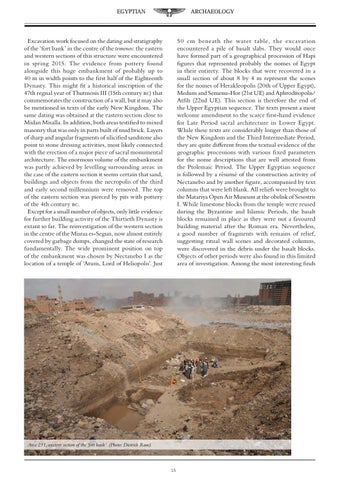
Excavation work focused on the dating and stratigraphy of the ‘fort bank’ in the centre of the temenos: the eastern and western sections of this structure were encountered in spring 2015. The evidence from pottery found alongside this huge embankment of probably up to 40 m in width points to the first half of the Eighteenth Dynasty. This might fit a historical inscription of the 47th regnal year of Thutmosis III (15th century bc) that commemorates the construction of a wall, but it may also be mentioned in texts of the early New Kingdom. The same dating was obtained at the eastern section close to Midan Misalla. In addition, both areas testified to mixed masonry that was only in parts built of mud brick. Layers of sharp and angular fragments of silicified sandstone also point to stone dressing activities, most likely connected with the erection of a major piece of sacral monumental architecture. The enormous volume of the embankment was partly achieved by levelling surrounding areas: in the case of the eastern section it seems certain that sand, buildings and objects from the necropolis of the third and early second millennium were removed. The top of the eastern section was pierced by pits with pottery of the 4th century bc. Except for a small number of objects, only little evidence for further building activity of the Thirtieth Dynasty is extant so far. The reinvestigation of the western section in the centre of the Misraa es-Segun, now almost entirely covered by garbage dumps, changed the state of research fundamentally. The wide prominent position on top of the embankment was chosen by Nectanebo I as the location of a temple of ‘Atum, Lord of Heliopolis’. Just
50 cm beneath the water table, the excavation encountered a pile of basalt slabs. They would once have formed part of a geographical procession of Hapi figures that represented probably the nomes of Egypt in their entirety. The blocks that were recovered in a small section of about 8 by 4 m represent the scenes for the nomes of Herakleopolis (20th of Upper Egypt), Medum and Semenu-Hor (21st UE) and Aphroditopolis/ Atfih (22nd UE). This section is therefore the end of the Upper Egyptian sequence. The texts present a most welcome amendment to the scarce first-hand evidence for Late Period sacral architecture in Lower Egypt. While these texts are considerably longer than those of the New Kingdom and the Third Intermediate Period, they are quite different from the textual evidence of the geographic processions with various fixed parameters for the nome descriptions that are well attested from the Ptolemaic Period. The Upper Egyptian sequence is followed by a résumé of the construction activity of Nectanebo and by another figure, accompanied by text columns that were left blank. All reliefs were brought to the Matariya Open Air Museum at the obelisk of Sesostris I. While limestone blocks from the temple were reused during the Byzantine and Islamic Periods, the basalt blocks remained in place as they were not a favoured building material after the Roman era. Nevertheless, a good number of fragments with remains of relief, suggesting ritual wall scenes and decorated columns, were discovered in the debris under the basalt blocks. Objects of other periods were also found in this limited area of investigation. Among the most interesting finds
Area 231, western section of the ‘fort bank’. (Photo: Dietrich Raue)
15