EGYPTIAN
ARCHAEOLOGY
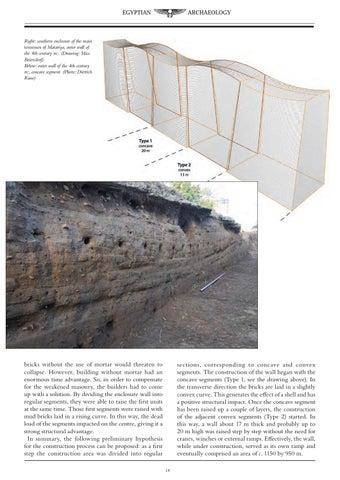
Right: southern enclosure of the main temenos of Matariya, outer wall of the 4th century bc. (Drawing: Max Beiersdorf) Below: outer wall of the 4th century bc, concave segment. (Photo: Dietrich Raue)
bricks without the use of mortar would threaten to collapse. However, building without mortar had an enormous time advantage. So, in order to compensate for the weakened masonry, the builders had to come up with a solution. By dividing the enclosure wall into regular segments, they were able to raise the first units at the same time. Those first segments were raised with mud bricks laid in a rising curve. In this way, the dead load of the segments impacted on the centre, giving it a strong structural advantage. In summary, the following preliminary hypothesis for the construction process can be proposed: as a first step the construction area was divided into regular
sections, corresponding to concave and convex segments. The construction of the wall began with the concave segments (Type 1, see the drawing above). In the transverse direction the bricks are laid in a slightly convex curve. This generates the effect of a shell and has a positive structural impact. Once the concave segment has been raised up a couple of layers, the construction of the adjacent convex segments (Type 2) started. In this way, a wall about 17 m thick and probably up to 20 m high was raised step by step without the need for cranes, winches or external ramps. Effectively, the wall, while under construction, served as its own ramp and eventually comprised an area of c. 1150 by 950 m. 14