EGYPTIAN
ARCHAEOLOGY
The Thirtieth Dynasty in the temple of Heliopolis Aiman Ashmawy, Max Beiersdorf and Dietrich Raue report on the spring season at Heliopolis, focusing on the enclosure walls of what was, in pharaonic times, one of the largest temple precincts in existence. The sun-temple of Heliopolis was the largest single temenos ever built in pharaonic Egypt. It was a place of pilgrimage from antiquity right up until the medieval era. Yet, there is little evidence of individual sanctuaries within the vast precinct of the main temenos at Matariya. Except for a structure of about 400 m in diameter, called the ‘fort bank of the Hyksos Period’ by its excavator W.M.F. Petrie, only few structures were observed and mapped in situ. These include the obelisk of Senusret I and the huge sphinxes at the western entrance of the temenos, as well as its enclosure walls.
It showed that the holes originally reached just about 1-1.3 m into the masonry. In contrast to, for example, the temple enclosure of Karnak, no pieces of wood were found in any of these holes. In Heliopolis, they can be interpreted as visible remains of scaffolding used to finish the outer shape of the wall. The vertical distance between the holes (about 1.8 m) would have provided enough space for the workers. The horizontal distance is about four ‘headers’, approximately 87 cm, easily bridged by simple planks that might have served as work platforms. The last hole at the end of the concave segment does
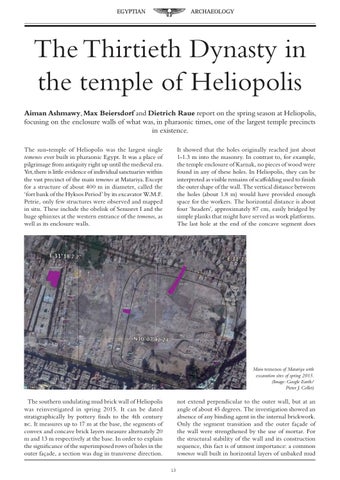
Main temenos of Matariya with excavation sites of spring 2015. (Image: Google Earth/ Pieter J. Collet)
The southern undulating mud brick wall of Heliopolis was reinvestigated in spring 2015. It can be dated stratigraphically by pottery finds to the 4th century bc. It measures up to 17 m at the base, the segments of convex and concave brick layers measure alternately 20 m and 13 m respectively at the base. In order to explain the significance of the superimposed rows of holes in the outer façade, a section was dug in transverse direction.
not extend perpendicular to the outer wall, but at an angle of about 45 degrees. The investigation showed an absence of any binding agent in the internal brickwork. Only the segment transition and the outer façade of the wall were strengthened by the use of mortar. For the structural stability of the wall and its construction sequence, this fact is of utmost importance: a common temenos wall built in horizontal layers of unbaked mud 13