EGYPTIAN
ARCHAEOLOGY
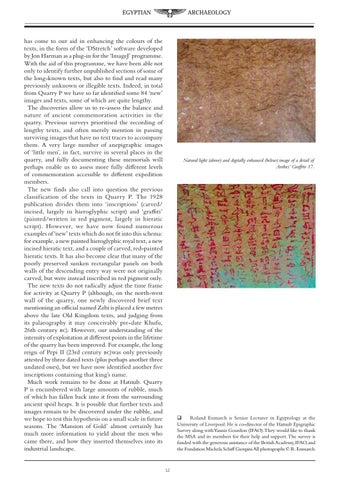
has come to our aid in enhancing the colours of the texts, in the form of the ‘DStretch’ software developed by Jon Harman as a plug-in for the ‘ImageJ’ programme. With the aid of this programme, we have been able not only to identify further unpublished sections of some of the long-known texts, but also to find and read many previously unknown or illegible texts. Indeed, in total from Quarry P we have so far identified some 84 ‘new’ images and texts, some of which are quite lengthy. The discoveries allow us to re-assess the balance and nature of ancient commemoration activities in the quarry. Previous surveys prioritised the recording of lengthy texts, and often merely mention in passing surviving images that have no text traces to accompany them. A very large number of anepigraphic images of ‘little men’, in fact, survive in several places in the quarry, and fully documenting these memorials will perhaps enable us to assess more fully different levels of commemoration accessible to different expedition members. The new finds also call into question the previous classif ication of the texts in Quarry P. The 1928 publication divides them into ‘inscriptions’ (carved/ incised, largely in hieroglyphic script) and ‘graffiti’ (painted/written in red pigment, largely in hieratic script). However, we have now found numerous examples of ‘new’ texts which do not fit into this schema: for example, a new painted hieroglyphic royal text, a new incised hieratic text, and a couple of carved, red-painted hieratic texts. It has also become clear that many of the poorly preserved sunken rectangular panels on both walls of the descending entry way were not originally carved, but were instead inscribed in red pigment only. The new texts do not radically adjust the time frame for activity at Quarry P (although, on the north-west wall of the quarry, one newly discovered brief text mentioning an official named Zebi is placed a few metres above the late Old Kingdom texts, and judging from its palaeography it may conceivably pre-date Khufu, 26th century bc). However, our understanding of the intensity of exploitation at different points in the lifetime of the quarry has been improved. For example, the long reign of Pepi II (23rd century bc)was only previously attested by three dated texts (plus perhaps another three undated ones), but we have now identified another five inscriptions containing that king’s name. Much work remains to be done at Hatnub. Quarry P is encumbered with large amounts of rubble, much of which has fallen back into it from the surrounding ancient spoil heaps. It is possible that further texts and images remain to be discovered under the rubble, and we hope to test this hypothesis on a small scale in future seasons. The ‘Mansion of Gold’ almost certainly has much more information to yield about the men who came there, and how they inserted themselves into its industrial landscape.
Natural light (above) and digitally enhanced (below) image of a detail of Anthes’ Graffito 17.
Roland Enmarch is Senior Lecturer in Egyptology at the University of Liverpool. He is co-director of the Hatnub Epigraphic Survey along with Yannis Gourdon (IFAO).They would like to thank the MSA and its members for their help and support. The survey is funded with the generous assistance of the British Academy, IFAO, and the Fondation Michela Schiff Giorgini All photographs © R. Enmarch.
12