EGYPTIAN
ARCHAEOLOGY
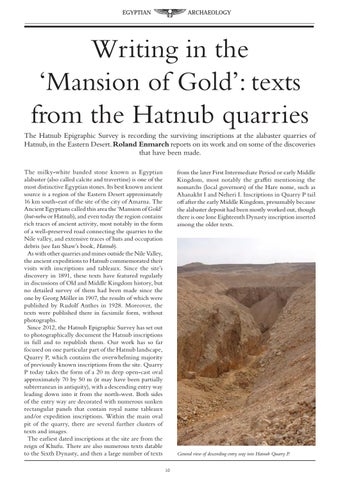
Writing in the ‘Mansion of Gold’: texts from the Hatnub quarries The Hatnub Epigraphic Survey is recording the surviving inscriptions at the alabaster quarries of Hatnub, in the Eastern Desert. Roland Enmarch reports on its work and on some of the discoveries that have been made. The milky-white banded stone known as Egyptian alabaster (also called calcite and travertine) is one of the most distinctive Egyptian stones. Its best known ancient source is a region of the Eastern Desert approximately 16 km south-east of the site of the city of Amarna. The Ancient Egyptians called this area the ‘Mansion of Gold’ (hut-nebu or Hatnub), and even today the region contains rich traces of ancient activity, most notably in the form of a well-preserved road connecting the quarries to the Nile valley, and extensive traces of huts and occupation debris (see Ian Shaw’s book, Hatnub). As with other quarries and mines outside the Nile Valley, the ancient expeditions to Hatnub commemorated their visits with inscriptions and tableaux. Since the site’s discovery in 1891, these texts have featured regularly in discussions of Old and Middle Kingdom history, but no detailed survey of them had been made since the one by Georg Möller in 1907, the results of which were published by Rudolf Anthes in 1928. Moreover, the texts were published there in facsimile form, without photographs. Since 2012, the Hatnub Epigraphic Survey has set out to photographically document the Hatnub inscriptions in full and to republish them. Our work has so far focused on one particular part of the Hatnub landscape, Quarry P, which contains the overwhelming majority of previously known inscriptions from the site. Quarry P today takes the form of a 20 m deep open-cast oval approximately 70 by 50 m (it may have been partially subterranean in antiquity), with a descending entry way leading down into it from the north-west. Both sides of the entry way are decorated with numerous sunken rectangular panels that contain royal name tableaux and/or expedition inscriptions. Within the main oval pit of the quarry, there are several further clusters of texts and images. The earliest dated inscriptions at the site are from the reign of Khufu. There are also numerous texts datable to the Sixth Dynasty, and then a large number of texts
from the later First Intermediate Period or early Middle Kingdom, most notably the graffiti mentioning the nomarchs (local governors) of the Hare nome, such as Ahanakht I and Neheri I. Inscriptions in Quarry P tail off after the early Middle Kingdom, presumably because the alabaster deposit had been mostly worked out, though there is one lone Eighteenth Dynasty inscription inserted among the older texts.
General view of descending entry way into Hatnub Quarry P. 10