EGYPTIAN
ARCHAEOLOGY
tomb of Osiris suggests that the return journey of the procession may have led directly back to the desert edge in the vicinity of the Nebhepetre mahat. From there, the god’s statue may have continued by boat back to the Osiris temple, thereby forming a circuit that linked the main Osiris temple and tomb with the royal cult buildings that stood along the desert margin facing peqer. The annual Osiris procession was the most important of a series of periodic religious festivals that would have made use of the Abydene landscape. However, it was not the only one. We can envision Nebhepetere’s canal functioning in other boat processions in which the gods of Abydos progressed by canal to visit outlying temples and sanctuaries. Having excavated the inner end of this decorated chamber, a key question now to be answered is: what else is preserved of the Nebhepetre mahat? Is this a single-room structure or have we exposed just one chamber within a more complex multi-room cult building? It is now crucial to expand excavation to define the wider format and setting of the building. The fact that the building type, a mahat, is explicit in the dedication text opens the unique possibility for investigating the design and functions of this particular temple type. The thematic focus on the sacred barques of Abydos suggests that additional decorated parts of the building, particularly the exterior walls, could well have scenes of barque processions. The building may in fact have also function as a barque shrine and perhaps preserves architectural elements connected to the processions. Future excavations should add significant new information on this cult building established at Abydos by the founder of the Middle Kingdom.
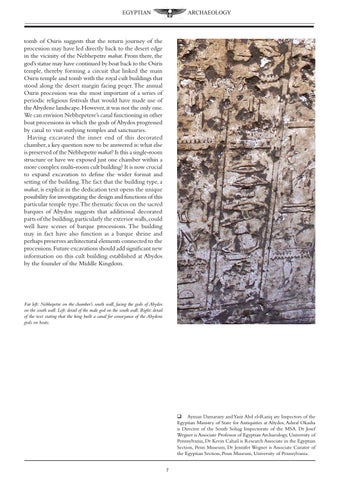
Far left: Nebhepetre on the chamber’s south wall, facing the gods of Abydos on the south wall. Left: detail of the male god on the south wall. Right: detail of the text stating that the king built a canal for conveyance of the Abydene gods on boats.
Ayman Damarany and Yasir Abd el-Raziq are Inspectors of the Egyptian Ministry of State for Antiquities at Abydos, Ashraf Okasha is Director of the South Sohag Inspectorate of the MSA. Dr Josef Wegner is Associate Professor of Egyptian Archaeology, University of Pennsylvania, Dr Kevin Cahail is Research Associate in the Egyptian Section, Penn Museum, Dr Jennifer Wegner is Associate Curator of the Egyptian Section, Penn Museum, University of Pennsylvania. 7