ARCHAEOLOGY
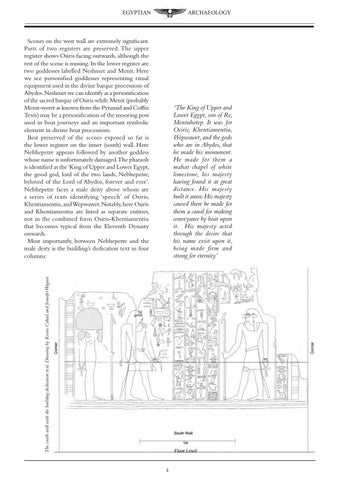
Scenes on the west wall are extremely significant. Parts of two registers are preserved. The upper register shows Osiris facing outwards, although the rest of the scene is missing. In the lower register are two goddesses labelled Neshmet and Menit. Here we see personified goddesses representing ritual equipment used in the divine barque processions of Abydos. Neshmet we can identify as a personification of the sacred barque of Osiris while Menit (probably Menit-weret as known from the Pyramid and Coffin Texts) may be a personification of the mooring post used in boat journeys and an important symbolic element in divine boat processions. Best preserved of the scenes exposed so far is the lower register on the inner (south) wall. Here Nebhepetre appears followed by another goddess whose name is unfortunately damaged.The pharaoh is identified as the ‘King of Upper and Lower Egypt, the good god, lord of the two lands, Nebhepetre, beloved of the Lord of Abydos, forever and ever’. Nebhepetre faces a male deity above whom are a series of texts identifying ‘speech’ of Osiris, Khentiamentiu, and Wepwawet. Notably, here Osiris and Khentiamentiu are listed as separate entities, not in the combined form Osiris-Khentiamentiu that becomes typical from the Eleventh Dynasty onwards. Most importantly, between Nebhepetre and the male deity is the building’s dedication text in four columns:
‘The King of Upper and Lower Egypt, son of Re, Mentuhotep. It was for Osiris, Khentiamentiu, Wepwawet, and the gods who are in Abydos, that he made his monument. He made for them a mahat chapel of white limestone, his majesty having found it at great distance. His majesty built it anew. His majesty caused there be made for them a canal for making conveyance by boat upon it. His majesty acted through the desire that his name exist upon it, being made firm and strong for eternity.’
The south wall with the building dedication text. Drawing by Kevin Cahail and Jennifer Wegner.
EGYPTIAN
5