EGYPTIAN
ARCHAEOLOGY
witnessed significant building activity during the Middle and New Kingdoms.What was the significance of this part of Abydos? The mahat of Nebhepetre offers new insights into this question. Although located significantly south of the main Osiris temple, the Nebhepetre chapel sits on the desert escarpment facing towards the heart of the Early Dynastic royal necropolis at Umm el-Qa’ab. The newly exposed building is oriented directly towards the tomb of Djer - the symbolic tomb of Osiris. It appears that while the low desert wadi that linked the Osiris temple and Umm el-Qa’ab formed the main ceremonial connection in the religious life of Abydos, the desert edge physically closest to and directly facing Umm el-Qa’ab had emerged by the early Middle Kingdom as a desired location for situating royal cult buildings dedicated to the veneration of Osiris. The work completed so far by the MSA has exposed a single 2.6 m wide chamber with its floor 4.2 meters below the modern surface. The exposure sits within a small culde-sac in the town of el-Arabah. The chamber is built of
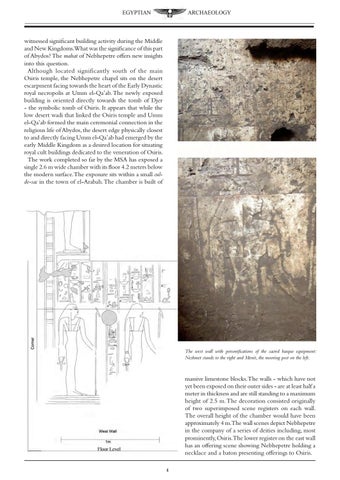
The west wall with personifications of the sacred barque equipment: Neshmet stands to the right and Menit, the mooring post on the left.
massive limestone blocks. The walls - which have not yet been exposed on their outer sides - are at least half a meter in thickness and are still standing to a maximum height of 2.5 m. The decoration consisted originally of two superimposed scene registers on each wall. The overall height of the chamber would have been approximately 4 m.The wall scenes depict Nebhepetre in the company of a series of deities including, most prominently, Osiris.The lower register on the east wall has an offering scene showing Nebhepetre holding a necklace and a baton presenting offerings to Osiris. 4