No. 47 Autumn 2015
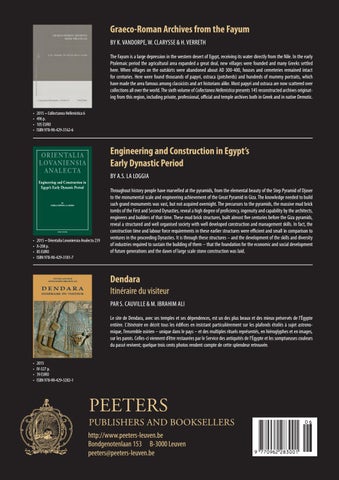
Graeco-Roman Archives from the Fayum
EGYPTIAN ARCHAEOLOGY
By K. Vandorpe, W. CLarysse & H. VerretH the Fayum is a large depression in the western desert of egypt, receiving its water directly from the nile. In the early ptolemaic period the agricultural area expanded a great deal, new villages were founded and many Greeks settled here. When villages on the outskirts were abandoned about ad 300-400, houses and cemeteries remained intact for centuries. Here were found thousands of papyri, ostraca (potsherds) and hundreds of mummy portraits, which have made the area famous among classicists and art historians alike. Most papyri and ostraca are now scattered over collections all over the world. the sixth volume of Collectanea Hellenistica presents 145 reconstructed archives originating from this region, including private, professional, official and temple archives both in Greek and in native demotic. • • • •
T he B ulletin of T he E gypt E xploration S ociety
2015 – Collectanea Hellenistica 6 496 p. 105 euro IsBn 978-90-429-3162-6
Engineering and Construction in Egypt’s Early Dynastic Period
O r i e n tA L i A L O vA n i e n s i A A n A L e c tA
A.s. LA LOggiA – engineering And cOnstructiOn in egyPt’s eArLy dynAstic PeriOd
OLA 239
By a.s. La LoGGIa
Engineering and Construction in Egypt’s Early Dynastic Period
by angela sophia la loggia
Peeters
Peeters
• • • •
2015 – orientalia Lovaniensia analecta 239 X-208 p. 85 euro IsBn 978-90-429-3181-7
SYLVIE CAUVILLE MOHAMMED IBRAHIM ALI
DENDA R A ITINÉRAIRE DU VISITEUR
Price £5.95
throughout history people have marvelled at the pyramids, from the elemental beauty of the step pyramid of djoser to the monumental scale and engineering achievement of the Great pyramid in Giza. the knowledge needed to build such grand monuments was vast, but not acquired overnight. the precursors to the pyramids, the massive mud brick tombs of the First and second dynasties, reveal a high degree of proficiency, ingenuity and capability by the architects, engineers and builders of that time. these mud brick structures, built almost five centuries before the Giza pyramids, reveal a structured and well organised society with well developed construction and management skills. In fact, the construction time and labour force requirements in these earlier structures were efficient and small in comparison to ventures in the proceeding dynasties. It is through these structures – and the development of the skills and diversity of industries required to sustain the building of them – that the foundation for the economic and social development of future generations and the dawn of large scale stone construction was laid.
Dendara Itinéraire du visiteur par s. CauVILLe & M. IBraHIM aLI Le site de dendara, avec ses temples et ses dépendences, est un des plus beaux et des mieux préservés de l’Égypte entière. L’Itinéraire en décrit tous les édifices en insistant particulièrement sur les plafonds étoilés à sujet astronomique, l’ensemble osirien – unique dans le pays – et des multiples rituels représentés, en hiéroglyphes et en images, sur les parois. Celles-ci viennent d’être restaurées par le service des antiquités de l’Égypte et les somptueuses couleurs du passé revivent; quelque trois cents photos rendent compte de cette splendeur retrouvée.
PEETERS
• • • •
2015 IV-327 p. 39 euro IsBn 978-90-429-3282-1
Peeters
Publishers and booksellers http://www.peeters-leuven.be Bondgenotenlaan 153 B-3000 Leuven peeters@peeters-leuven.be
97925_Ad_EgyptArchaeology2015.indd 1
EA 47_Cover_outside.indd 2-3
6/08/15 08:12
29/10/2015 18:29:03