EGYPTIAN
The Complete Cities is informed by the author’s first-hand knowledge of sites and research literature. One might have wished that he had ventured further out beyond the description of the evidence and the discussions associated with it. That said, the book is a pleasant read for all those interested in the more mundane aspects of life in ancient Egypt. The bibliography is short, but useful and up-to-date. There is currently no alternative single-authored overview of ancient Egyptian settlements written by a leading researcher in the field. Recommended. RICHARD BUSSMANN
ARCHAEOLOGY
visual products and the primary ancient functions of sculpture are particularly valuable. The author’s ability to provide genuinely new insights on the turgid topic of the display of Egyptian human remains, and especially the meaning of mummification, stands out. Yet Riggs’ sympathy for the ancient actors does not extend to her Egyptological forebears, and some sections are of a jarringly personal character. With regard to Riggs’ objections to the ‘scientific’ investigation of mummies, it is difficult to visualise an alternative to the human curiosity that motivated the investigations, and which continues to produce presentations like the British Museum’s current (extended) ‘Ancient Lives’ exhibition. Object biographies, as Riggs herself contends, do not end simply because things are placed in museums. The discussion, therefore, perhaps underplays the validity of new meanings given to museum objects, including mummies, in modern times. Riggs is, undeniably, spot-on with many of her observations. She is deliberately provocative and hopefully this book – an affordable paperback that reach a wide audience – will not simply be dismissed as ‘trendy’ by the Establishment she critiques. How those critiques inform future discussions and presentations of ancient Egypt remain to be seen, though it should please the author that the book – perhaps the single most important on the subject of ‘Egyptology’ as a discipline of the last ten years – is already on the set reading list of archaeology students at Manchester University. CAMPBELL PRICE
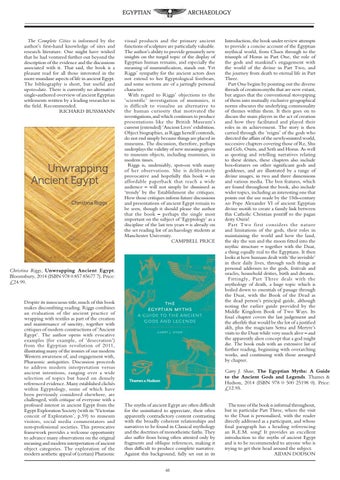
Christina Riggs, Unwrapping Ancient Egypt. Bloomsbury, 2014 (ISBN 978 0 857 85677 7). Price: £24.99.
Despite its innocuous title, much of this book makes discomfiting reading. Riggs combines an evaluation of the ancient practice of wrapping with textiles as part of the creation and maintenance of sanctity, together with critiques of modern constructions of ‘Ancient Egypt’. The author opens with evocative examples (for example, of ‘desecration’) from the Egyptian revolution of 2011, illustrating many of the ironies of our modern Western awareness of, and engagement with, Pharaonic antiquities. Discussion proceeds to address modern interpretation versus ancient intentions, ranging over a wide selection of topics but based on densely referenced evidence. Many established clichés within Egyptology, some of which have been previously considered elsewhere, are challenged, with critique of everyone with a professed interest in ancient Egypt from the Egypt Exploration Society (with its ‘Victorian conceit of Exploration’, p.59) to museum visitors, social media commentators and non-professional societies. This provocative framework provides a welcome opportunity to advance many observations on the original meaning and modern interpretation of ancient object categories. The exploration of the modern aesthetic appeal of (certain) Pharaonic
Introduction, the book under review attempts to provide a concise account of the Egyptian mythical world, from Chaos through to the triumph of Horus in Part One, the role of the gods and mankind’s engagement with the world of the divine in Part Two, and the journey from death to eternal life in Part Three. Part One begins by pointing out the diverse threads of creation-myths that are now extant, but argues that the conventional stovepiping of them into mutually exclusive geographical norms obscures the underlying commonality of themes within them. It then goes on to discuss the main players in the act of creation and how they facilitated and played their roles in its achievement. The story is then carried through the ‘reigns’ of the gods who directed the affairs of the newly-minted world, successive chapters covering those of Re, Shu and Geb, Osiris, and Seth and Horus. As well as quoting and retelling narratives relating to these deities, these chapters also include box-features on other significant gods and goddesses, and are illustrated by a range of divine images, in two and three dimensions and various media. The box features, which are found throughout the book, also include wider topics, including an interesting one that points out the use made by the 15th-century ad Pope Alexander VI of ancient Egyptian divine motifs to create a family link between this Catholic Christian pontiff to the pagan deity Osiris! Part Two first considers the nature and limitations of the gods, their roles in maintaining the world and how the land, the sky the sun and the moon fitted into the mythic structure – together with the Duat, a thing equally real to the Egyptians. It then looks at how humans dealt with ‘the invisible’ in their daily lives, through such things as personal addresses to the gods, festivals and oracles, household deities, birth and dreams. Fittingly, Part Three deals with the mythology of death, a huge topic which is boiled down to essentials of passage through the Duat, with the Book of the Dead as the dead person’s principal guide, although noting the earlier guide provided by the Middle Kingdom Book of Two Ways. Its final chapter covers the last judgement and the afterlife that would be the lot of a justified akh, plus the magicians Setna and Meryre’s visits to the Duat while very much alive – and the apparently alien concept that a god might die. The book ends with an extensive list of further reading, beginning with overarching works, and continuing with those arranged by chapter. Garry J. Shaw, The Egyptian Myths: A Guide to the Ancient Gods and Legends. Thames & Hudson, 2014 (ISBN 978 0 500 25198 0). Price: £12.95.
The myths of ancient Egypt are often difficult for the uninitiated to appreciate, their often apparently contradictory content contrasting with the broadly coherent relationships and narratives to be found in Classical mythology and the doctrines of monotheistic faiths. They also suffer from being often attested only by fragments and oblique references, making it thus difficult to produce complete narrative. Against this background, fully set out in its 48
The tone of the book is informal throughout, but in particular Part Three, where the visit to the Duat is personalised, with the reader directly addressed as a participant, and whose final paragraph has a heading referencing an R.E.M. song! It provides an excellent introduction to the myths of ancient Egypt and is to be recommended to anyone who is trying to get their head around the subject. AIDAN DODSON