EGYPTIAN
ARCHAEOLOGY
Bookshelf
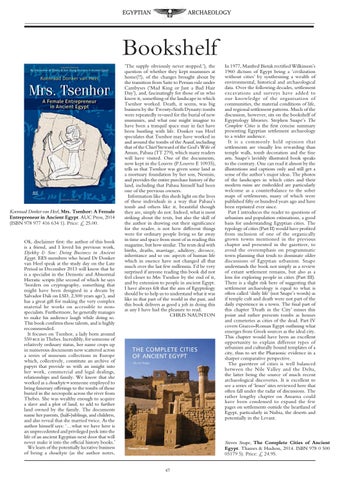
Koenraad Donker van Heel, Mrs. Tsenhor: A Female Entrepreneur in Ancient Egypt. AUC Press, 2014 (ISBN 978 977 416 634 1). Price: £ 25.00.
Ok, disclaimer first: the author of this book is a friend, and I loved his previous work, Djekhy & Son: Doing Business in Ancient Egypt. EES members who heard Dr Donker van Heel speak at the study day on the Late Period in December 2013 will know that he is a specialist in the Demotic and Abnormal Hieratic scripts (the second of which he says ‘borders on cryptography, something that might have been designed in a dream by Salvador Dali on LSD, 2,500 years ago’), and has a great gift for making the very complex material he works on accessible to nonspecialists. Furthermore, he generally manages to make his audience laugh while doing so. This book confirms these talents, and is highly recommended. It focuses on Tsenhor, a lady born around 550 bce in Thebes. Incredibly, for someone of relatively ordinary status, her name crops up in numerous documents now scattered across a series of museum collections in Europe which, collectively, constitute an archive of papyri that provide us with an insight into her work, commercial and legal dealings, relationships and family. We know that she worked as a choachyte – someone employed to bring funerary offerings to the tombs of those buried in the necropolis across the river from Thebes. She was wealthy enough to acquire a slave and a plot of land, to add to further land owned by the family. The documents name her parents, (half-)siblings, and children, and also reveal that she married twice. As the author himself says: ‘…what we have here is an unprecedented and privileged peek into the life of an ancient Egyptian next door that will never make it into the official history books.’ We learn of the potentially lucrative business of being a choachyte (as the author notes,
‘The supply obviously never stopped.’), the question of whether they kept mummies at home(?!), of the changes brought about by the transition from Saite to Persian rule under Cambyses (‘Mad King or Just a Bad Hair Day’), and, fascinatingly for those of us who know it, something of the landscape in which Tsenhor worked. Death, it seems, was big business by the Twenty-Sixth Dynasty: tombs were repeatedly re-used for the burial of new mummies, and what one might imagine to have been a tranquil space may in fact have been bustling with life. Donker van Heel speculates that Tsenhor may have worked in and around the tombs of the Asasif, including that of the Chief Steward of the God’s Wife of Amun, Pabasa (TT 279), which many readers will have visited. One of the documents, now kept in the Louvre (P.Louvre E 10935), tells us that Tsenhor was given some land as a mortuary foundation by her son, Nesmin, and provides the entire purchase history of the land, including that Pabasa himself had been one of the previous owners. Information like this sheds light on the lives of these individuals in a way that Pabasa’s tomb and others like it, beautiful though they are, simply do not. Indeed, what is most striking about the texts, but also the skill of the author in drawing out their significance for the reader, is not how different things were for ordinary people living so far away in time and space from most of us reading this magazine, but how similar. The texts deal with births, deaths, marriage, adultery, divorce, inheritance and so on: aspects of human life which in essence have not changed all that much over the last few millennia. I’d be very surprised if anyone reading this book did not feel closer to Mrs Tsenhor by the end of it, and by extension to people in ancient Egypt. I have always felt that the aim of Egyptology should be to help us to understand what it was like in that part of the world in the past, and this book delivers as good a job in doing this as any I have had the pleasure to read. CHRIS NAUNTON
In 1977, Manfred Bietak rectified Wilkinson’s 1960 dictum of Egypt being a ‘civilization without cities’ by synthesising a wealth of environmental, historical and archaeological data. Over the following decades, settlement excavations and surveys have added to our knowledge of the organisation of communities, the material conditions of life, and regional settlement patterns. Much of the discussion, however, sits on the bookshelf of Egyptology libraries. Stephen Snape’s The Complete Cities is the first concise summary presenting Egyptian settlement archaeology to a wider audience. It is a commonly held opinion that settlements are visually less rewarding than temple walls, tomb decoration and the fine arts. Snape’s lavishly illustrated book speaks to the contrary. One can read it almost by the illustrations and captions only and still get a sense of the author’s major ideas. The photos of the landscapes in which cities and their modern ruins are embedded are particularly welcome as a counterbalance to the sober maps of settlements, many of which were published fifty or hundred years ago and have been reprinted ever since. Part I introduces the reader to questions of urbanism and population estimations, a good basis for understanding Egyptian cities. The typology of cities (Part II) would have profited from inclusion of one of the organically grown towns mentioned in the previous chapter and presented in the gazetteer, to avoid the overemphasis on programmatic town planning that tends to dominate older discussions of Egyptian urbanism. Snape understands the book not simply as a review of extant settlement remains, but also as a lens for exploring people in cities (Part III). There is a slight risk here of suggesting that settlement archaeology is equal to what is often called ‘daily life’ (not Snape’s words) as if temple cult and death were not part of the daily experience in a town. The final part of this chapter ‘Death in the City’ misses this point and rather presents tombs as houses and cemeteries as cities of the dead. Part IV covers Graeco-Roman Egypt outlining what emerges from Greek sources as the ideal city. This chapter would have been an excellent opportunity to explain different types of urbanism and culturally bound templates of a city, thus to set the Pharaonic evidence in a sharper comparative perspective. The gazetteer of cities is well balanced between the Nile Valley and the Delta, the latter being the source of much recent archaeological discoveries. It is excellent to see a series of ‘lesser’ sites reviewed here that often fall under the radar of discussions. The rather lengthy chapter on Amarna could have been condensed to expand the few pages on settlements outside the heartland of Egypt, particularly in Nubia, the deserts and potentially in the Levant.
Steven Snape, The Complete Cities of Ancient Egypt. Thames & Hudson, 2014. ISBN 978 0 500 05179 5). Price: £ 24.95. 47