EGYPTIAN
ARCHAEOLOGY
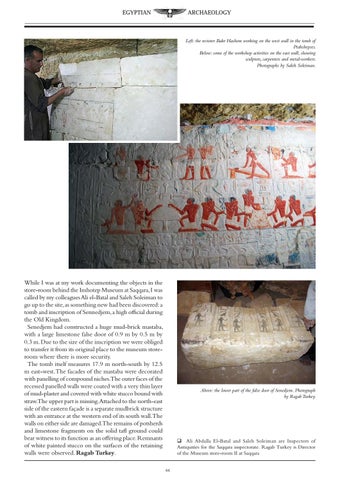
Left: the restorer Bakr Hashem working on the west wall in the tomb of Ptahshepses. Below: some of the workshop activities on the east wall, showing sculptors, carpenters and metal-workers. Photographs by Saleh Soleiman.
While I was at my work documenting the objects in the store-room behind the Imhotep Museum at Saqqara, I was called by my colleagues Ali el-Batal and Saleh Soleiman to go up to the site, as something new had been discovered: a tomb and inscription of Sennedjem, a high official during the Old Kingdom. Senedjem had constructed a huge mud-brick mastaba, with a large limestone false door of 0.9 m by 0.5 m by 0.3 m. Due to the size of the inscription we were obliged to transfer it from its original place to the museum storeroom where there is more security. The tomb itself measures 17.9 m north-south by 12.5 m east-west. The facades of the mastaba were decorated with panelling of compound niches.The outer faces of the recessed panelled walls were coated with a very thin layer of mud-plaster and covered with white stucco bound with straw.The upper part is missing.Attached to the north-east side of the eastern façade is a separate mudbrick structure with an entrance at the western end of its south wall.The walls on either side are damaged.The remains of potsherds and limestone fragments on the solid tafl ground could bear witness to its function as an offering place. Remnants of white painted stucco on the surfaces of the retaining walls were observed. Ragab Turkey.
Above: the lower part of the false door of Senedjem. Photograph by Ragab Turkey.
ď ą Ali Abdalla El-Batal and Saleh Soleiman are Inspectors of Antiquities for the Saqqara inspectorate. Ragab Turkey is Director of the Museum store-room II at Saqqara 44