EGYPTIAN
ARCHAEOLOGY
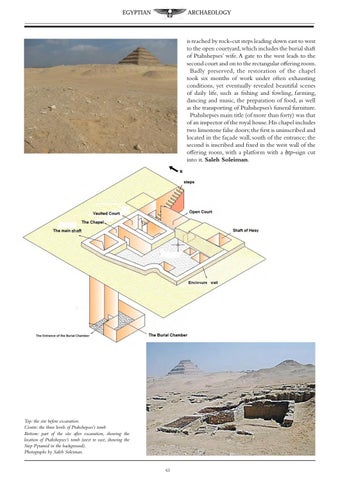
is reached by rock-cut steps leading down east to west to the open courtyard, which includes the burial shaft of Ptahshepses’ wife. A gate to the west leads to the second court and on to the rectangular offering room. Badly preserved, the restoration of the chapel took six months of work under often exhausting conditions, yet eventually revealed beautiful scenes of daily life, such as fishing and fowling, farming, dancing and music, the preparation of food, as well as the transporting of Ptahshepses’s funeral furniture. Ptahshepses main title (of more than forty) was that of an inspector of the royal house. His chapel includes two limestone false doors; the first is uninscribed and located in the façade wall, south of the entrance; the second is inscribed and fixed in the west wall of the offering room, with a platform with a ḥtp-sign cut into it. Saleh Soleiman.
Top: the site before excavation. Centre: the three levels of Ptahshepses’s tomb Bottom: part of the site after excavation, showing the location of Ptahshepses’s tomb (west to east, showing the Step Pyramid in the background). Photographs by Saleh Soleiman. 43