EGYPTIAN
ARCHAEOLOGY
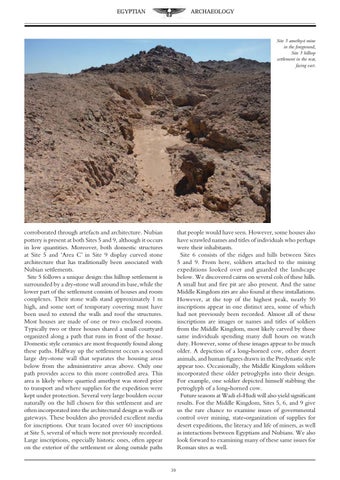
Site 5 amethyst mine in the foreground, Site 5 hilltop settlement in the rear, facing east.
corroborated through artefacts and architecture. Nubian pottery is present at both Sites 5 and 9, although it occurs in low quantities. Moreover, both domestic structures at Site 5 and ‘Area C’ in Site 9 display curved stone architecture that has traditionally been associated with Nubian settlements. Site 5 follows a unique design: this hilltop settlement is surrounded by a dry-stone wall around its base, while the lower part of the settlement consists of houses and room complexes. Their stone walls stand approximately 1 m high, and some sort of temporary covering must have been used to extend the walls and roof the structures. Most houses are made of one or two enclosed rooms. Typically two or three houses shared a small courtyard organized along a path that runs in front of the house. Domestic style ceramics are most frequently found along these paths. Halfway up the settlement occurs a second large dry-stone wall that separates the housing areas below from the administrative areas above. Only one path provides access to this more controlled area. This area is likely where quarried amethyst was stored prior to transport and where supplies for the expedition were kept under protection. Several very large boulders occur naturally on the hill chosen for this settlement and are often incorporated into the architectural design as walls or gateways. These boulders also provided excellent media for inscriptions. Our team located over 60 inscriptions at Site 5, several of which were not previously recorded. Large inscriptions, especially historic ones, often appear on the exterior of the settlement or along outside paths
that people would have seen. However, some houses also have scrawled names and titles of individuals who perhaps were their inhabitants. Site 6 consists of the ridges and hills between Sites 5 and 9. From here, soldiers attached to the mining expeditions looked over and guarded the landscape below. We discovered cairns on several cols of these hills. A small hut and fire pit are also present. And the same Middle Kingdom zirs are also found at these installations. However, at the top of the highest peak, nearly 50 inscriptions appear in one distinct area, some of which had not previously been recorded. Almost all of these inscriptions are images or names and titles of soldiers from the Middle Kingdom, most likely carved by those same individuals spending many dull hours on watch duty. However, some of these images appear to be much older. A depiction of a long-horned cow, other desert animals, and human figures drawn in the Predynastic style appear too. Occasionally, the Middle Kingdom soldiers incorporated these older petroglyphs into their design. For example, one soldier depicted himself stabbing the petroglyph of a long-horned cow. Future seasons at Wadi el-Hudi will also yield significant results. For the Middle Kingdom, Sites 5, 6, and 9 give us the rare chance to examine issues of governmental control over mining, state-organization of supplies for desert expeditions, the literacy and life of miners, as well as interactions between Egyptians and Nubians. We also look forward to examining many of these same issues for Roman sites as well.
39