EGYPTIAN
ARCHAEOLOGY
Gems in the desert: recent work at Wadi el-Hudi In May 2014, Kate Liszka and her team initiated the first Princeton University mission to Wadi el-Hudi. Hidden in an arid landscape of granite and dolerite mountainous outcrops, 35 kilometres southeast of Aswan, lie at least 14 archaeological sites in an area called Wadi elHudi. These sites include fortified settlements, amethyst mines, over 100 rock inscriptions, and even an Egyptianstyle fortress, which date to the Middle Kingdom and the Roman Period. The degree of archaeological preservation is astonishing, with sites exposed like time capsules. Dry-stone walls often stand at their original heights of approximately two metres, and artefact scatters appear on the surface where the Ancient Egyptians left them millennia ago. The patterns of artefact distribution are so clear that they can allow us to reconstruct the ancient activities that took place.
Previous examinations of the inscriptions, archaeology, and geology at Wadi el-Hudi have occurred sporadically and briefly over the last century. The geologist Labib Nassim first discovered the sites in 1917. In 1938, the Survey of Egypt desert topographers rediscovered the amethyst mines and removed several important inscriptions to the Cairo Museum. In 1952, Ahmed Fakhry published many of the inscriptions. In 1992, Ian Shaw led a short survey of the archaeological sites as part of a larger study of mining settlements, and Rosemarie and Dietrich Klemm examined some of the geology and ruins related to gold mining in 1993. Yet, for the most part, Wadi el-Hudi remains understudied despite its potential to shed light on questions of urbanism, organization of
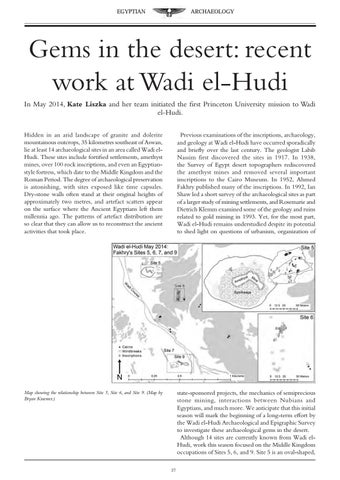
Map showing the relationship between Site 5, Site 6, and Site 9. (Map by Bryan Kraemer.)
state-sponsored projects, the mechanics of semiprecious stone mining, interactions between Nubians and Egyptians, and much more. We anticipate that this initial season will mark the beginning of a long-term effort by the Wadi el-Hudi Archaeological and Epigraphic Survey to investigate these archaeological gems in the desert. Although 14 sites are currently known from Wadi elHudi, work this season focused on the Middle Kingdom occupations of Sites 5, 6, and 9. Site 5 is an oval-shaped, 37