EGYPTIAN
ARCHAEOLOGY
East, Dihmit-South and El Hisnein-West forts. The perimeter walls at the El Hisnein-East and Dihmit-South forts include semi-circular bastions and loopholes, and these sites are additionally notable for the remains outside the forts, a collapsed hilltop redoubt at El Hisnein-East, and at DihmitSouth well-built and preserved houses with walls like those in the fort. All the mines beside these forts have been reopened in recent years with this gold-mining activity seriously damaging the El Hisnein-West site. All the forts are well dated by pottery to the Middle Kingdom, and especially the Twelfth Dynasty, with the one at Dihmit South also associated with several hieroglyphic inscriptions, one of which is dated to year 31 of Senusret I. Also, on the same sandstone block with these inscriptions, there is rock art attributable to the Nubian C-Group culture.
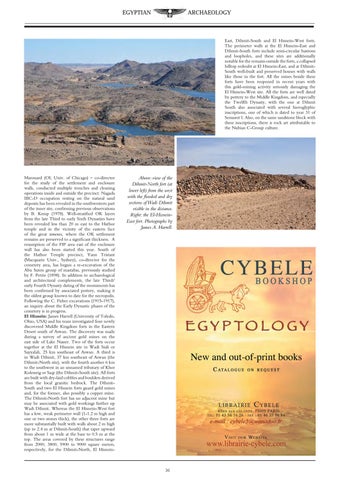
Marouard (OI, Univ. of Chicago) – co-director for the study of the settlement and enclosure walls, conducted multiple trenches and cleaning operations inside and outside the precinct. Nagada IIIC-D occupation resting on the natural sand deposits has been revealed in the southwestern part of the inner site, confirming previous observations by B. Kemp (1978). Well-stratified OK layers from the late Third to early Sixth Dynasties have been revealed less than 20 m east to the Hathor temple and in the vicinity of the eastern face of the great temenos, where the OK settlement remains are preserved to a significant thickness. A resumption of the FIP area east of the enclosure wall has also been started this year. South of the Hathor Temple precinct, Yann Tristant (Macquarie Univ., Sydney), co-director for the cemetery area, has begun a re-excavation of the Abu Suten group of mastabas, previously studied by F. Petrie (1898). In addition to archaeological and architectural complements, the late Third/ early Fourth Dynasty dating of the monuments has been confirmed by associated pottery, making it the oldest group known to date for the necropolis. Following the C. Fisher excavations (1915-1917), an inquiry about the Early Dynastic phases of the cemetery is in progress. El Hisnein: James Harrell (University of Toledo, Ohio, USA) and his team investigated four newly discovered Middle Kingdom forts in the Eastern Desert south of Aswan. The discovery was made during a survey of ancient gold mines on the east side of Lake Nasser. Two of the forts occur together at the El Hisnein site in Wadi Siali or Sayyalah, 25 km southeast of Aswan. A third is in Wadi Dihmit, 37 km southeast of Aswan (the Dihmit-North site), with the fourth another 6 km to the southwest in an unnamed tributary of Khor Kolesseig or Saqr (the Dihmit-South site). All forts are built with dry-laid cobbles and boulders derived from the local granitic bedrock. The DihmitSouth and two El Hisnein forts guard gold mines and, for the former, also possibly a copper mine. The Dihmit-North fort has no adjacent mine but may be associated with gold workings further up Wadi Dihmit. Whereas the El Hisnein-West fort has a low, weak perimeter wall (1-1.2 m high and one or two stones thick), the other three forts are more substantially built with walls about 2 m high (up to 2.4 m at Dihmit-South) that taper upward from about 1 m wide at the base to 0.5 m at the top. The areas covered by these structures range from 2000, 3800, 5900 to 9000 square meters, respectively, for the Dihmit-North, El Hisnein-
Above: view of the Dihmit-North fort (at lower left) from the west with the flooded and dry sections of Wadi Dihmit visible in the distance. Right: the El-HisneinEast fort. Photographs by James A. Harrell.
36