ARCHAEOLOGY
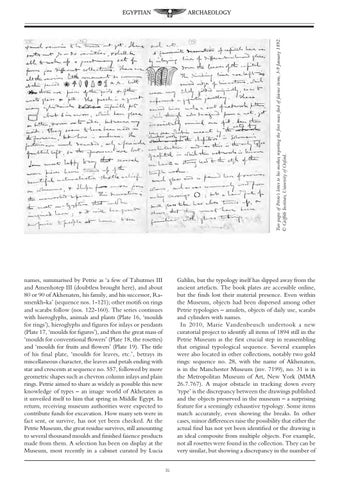
Two pages of Petrie’s letter to his mother, reporting the first mass find of faience items, 3-9 January 1892. © Griffith Institute, University of Oxford.
EGYPTIAN
names, summarised by Petrie as ‘a few of Tahutmes III and Amenhotep III (doubtless brought here), and about 80 or 90 of Akhenaten, his family, and his successor, Rasmenkh-ka’ (sequence nos. 1-121); other motifs on rings and scarabs follow (nos. 122-160). The series continues with hieroglyphs, animals and plants (Plate 16, ‘moulds for rings’), hieroglyphs and figures for inlays or pendants (Plate 17, ‘moulds for figures’), and then the great mass of ‘moulds for conventional flowers’ (Plate 18, the rosettes) and ‘moulds for fruits and flowers’ (Plate 19). The title of his final plate, ‘moulds for leaves, etc.’, betrays its miscellaneous character, the leaves and petals ending with star and crescents at sequence no. 557, followed by more geometric shapes such as chevron column inlays and plain rings. Petrie aimed to share as widely as possible this new knowledge of types – an image world of Akhetaten as it unveiled itself to him that spring in Middle Egypt. In return, receiving museum authorities were expected to contribute funds for excavation. How many sets were in fact sent, or survive, has not yet been checked. At the Petrie Museum, the great residue survives, still amounting to several thousand moulds and finished faience products made from them. A selection has been on display at the Museum, most recently in a cabinet curated by Lucia
Gahlin, but the typology itself has slipped away from the ancient artefacts. The book plates are accessible online, but the finds lost their material presence. Even within the Museum, objects had been dispersed among other Petrie typologies – amulets, objects of daily use, scarabs and cylinders with names. In 2010, Marie Vandenbeusch undertook a new curatorial project to identify all items of 1894 still in the Petrie Museum as the first crucial step in reassembling that original typological sequence. Several examples were also located in other collections, notably two gold rings: sequence no. 28, with the name of Akhenaten, is in the Manchester Museum (inv. 7199), no. 31 is in the Metropolitan Museum of Art, New York (MMA 26.7.767). A major obstacle in tracking down every ‘type’ is the discrepancy between the drawings published and the objects preserved in the museum – a surprising feature for a seemingly exhaustive typology. Some items match accurately, even showing the breaks. In other cases, minor differences raise the possibility that either the actual find has not yet been identified or the drawing is an ideal composite from multiple objects. For example, not all rosettes were found in the collection. They can be very similar, but showing a discrepancy in the number of 31