EGYPTIAN
ARCHAEOLOGY
individuals whose names were not otherwise dispersed along with the finds. That workforce also included numerous Western personalities who are mentioned only in passing in excavation memoirs and whose careers have made little impression upon the discipline. These people have a very limited presence in central London’s archives, but their stories remain to be uncovered in other repositories Far left: Old Kingdom stone vessel.The markings record its collection history from it excavation from Mostagedda (tomb 10012), its acquisition by Henry Wellcome (R4031/1537) and finally it being accessioned into the Petrie Museum of Egyptian Archaeology, UCL (UC25504).
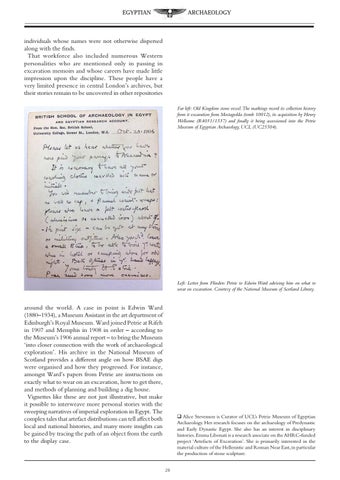
Left: Letter from Flinders Petrie to Edwin Ward advising him on what to wear on excavation. Courtesy of the National Museum of Scotland Library.
around the world. A case in point is Edwin Ward (1880–1934), a Museum Assistant in the art department of Edinburgh’s Royal Museum. Ward joined Petrie at Rifeh in 1907 and Memphis in 1908 in order – according to the Museum’s 1906 annual report – to bring the Museum ‘into closer connection with the work of archaeological exploration’. His archive in the National Museum of Scotland provides a different angle on how BSAE digs were organised and how they progressed. For instance, amongst Ward’s papers from Petrie are instructions on exactly what to wear on an excavation, how to get there, and methods of planning and building a dig house. Vignettes like these are not just illustrative, but make it possible to interweave more personal stories with the sweeping narratives of imperial exploration in Egypt. The complex tales that artefact distributions can tell affect both local and national histories, and many more insights can be gained by tracing the path of an object from the earth to the display case.
Alice Stevenson is Curator of UCL’s Petrie Museum of Egyptian Archaeology. Her research focuses on the archaeology of Predynastic and Early Dynastic Egypt. She also has an interest in disciplinary histories. Emma Libonati is a research associate on the AHRC-funded project ‘Artefacts of Excavation’. She is primarily interested in the material culture of the Hellenistic and Roman Near East, in particular the production of stone sculpture. 29