EGYPTIAN
ARCHAEOLOGY
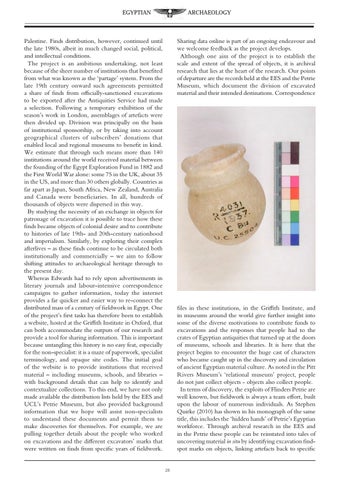
Palestine. Finds distribution, however, continued until the late 1980s, albeit in much changed social, political, and intellectual conditions. The project is an ambitious undertaking, not least because of the sheer number of institutions that benefited from what was known as the ‘partage’ system. From the late 19th century onward such agreements permitted a share of finds from officially-sanctioned excavations to be exported after the Antiquities Service had made a selection. Following a temporary exhibition of the season’s work in London, assemblages of artefacts were then divided up. Division was principally on the basis of institutional sponsorship, or by taking into account geographical clusters of subscribers’ donations that enabled local and regional museums to benefit in kind. We estimate that through such means more than 140 institutions around the world received material between the founding of the Egypt Exploration Fund in 1882 and the First World War alone: some 75 in the UK, about 35 in the US, and more than 30 others globally. Countries as far apart as Japan, South Africa, New Zealand, Australia and Canada were beneficiaries. In all, hundreds of thousands of objects were dispersed in this way. By studying the necessity of an exchange in objects for patronage of excavation it is possible to trace how these finds became objects of colonial desire and to contribute to histories of late 19th- and 20th-century nationhood and imperialism. Similarly, by exploring their complex afterlives – as these finds continue to be circulated both institutionally and commercially – we aim to follow shifting attitudes to archaeological heritage through to the present day. Whereas Edwards had to rely upon advertisements in literary journals and labour-intensive correspondence campaigns to gather information, today the internet provides a far quicker and easier way to re-connect the distributed mass of a century of fieldwork in Egypt. One of the project’s first tasks has therefore been to establish a website, hosted at the Griffith Institute in Oxford, that can both accommodate the outputs of our research and provide a tool for sharing information. This is important because untangling this history is no easy feat, especially for the non-specialist: it is a maze of paperwork, specialist terminology, and opaque site codes. The initial goal of the website is to provide institutions that received material – including museums, schools, and libraries – with background details that can help to identify and contextualize collections. To this end, we have not only made available the distribution lists held by the EES and UCL’s Petrie Museum, but also provided background information that we hope will assist non-specialists to understand these documents and permit them to make discoveries for themselves. For example, we are pulling together details about the people who worked on excavations and the different excavators’ marks that were written on finds from specific years of fieldwork.
Sharing data online is part of an ongoing endeavour and we welcome feedback as the project develops. Although one aim of the project is to establish the scale and extent of the spread of objects, it is archival research that lies at the heart of the research. Our points of departure are the records held at the EES and the Petrie Museum, which document the division of excavated material and their intended destinations. Correspondence
files in these institutions, in the Griffith Institute, and in museums around the world give further insight into some of the diverse motivations to contribute funds to excavations and the responses that people had to the crates of Egyptian antiquities that turned up at the doors of museums, schools and libraries. It is here that the project begins to encounter the huge cast of characters who became caught up in the discovery and circulation of ancient Egyptian material culture. As noted in the Pitt Rivers Museum’s ‘relational museum’ project, people do not just collect objects - objects also collect people. In terms of discovery, the exploits of Flinders Petrie are well known, but fieldwork is always a team effort, built upon the labour of numerous individuals. As Stephen Quirke (2010) has shown in his monograph of the same title, this includes the ‘hidden hands’ of Petrie’s Egyptian workforce. Through archival research in the EES and in the Petrie these people can be reinstated into tales of uncovering material in situ by identifying excavation findspot marks on objects, linking artefacts back to specific 28