EGYPTIAN
ARCHAEOLOGY
Artefacts of excavation Alice Stevenson and Emma Libonati on the AHRC-funded project ‘Artefacts of Excavation’, which aims to examine the practice of object distribution and its impact on archaeology, Egyptology and museums. In September 1883 Amelia B. Edwards stood before the Sixth Oriental Congress in Leiden and enquired: ‘Is there then no possibility of organising some system of enquiry by means of which information may be sought and collected throughout Europe and America, whereby the particulars of dispersed relics may be collected for the benefit of science?’ More than one hundred and thirty years later a new collaborative project between the University of Oxford, University College London, and the EES is attempting to address that very same problem, this time for material excavated by the EES and Petrie’s British School of Archaeology in Egypt (BSAE).
‘Artefacts of Excavation’ is a three-year project, funded by the UK’s Arts and Humanities Research Council (AHRC), which is investigating the international distribution of archaeological finds from EEF/EES and BSAE excavations between 1880 and 1980. Scouring through museum collections, pouring over object catalogues, and sifting across archives for information about dispersed antiquities are activities on which many Egyptologists have spent countless hours, either tracking down objects from particular excavations or building up histories of specific museum collections. What there has never been is a critical examination of the whole practice of distribution or how it impacted upon the development of – and relationships between – archaeology, Egyptology, and museums. Previous work has also tended to focus only upon the early period of exploration up until 1925, the year Petrie left to excavate in ‘Egypt over the border’,
London exhibition of finds from the BSAE Hawara excavations of 1911. Some of the Roman mummy portraits that can be seen are now in museums in Brooklyn, Copenhagen, Edinburgh, Manchester and Oxford.
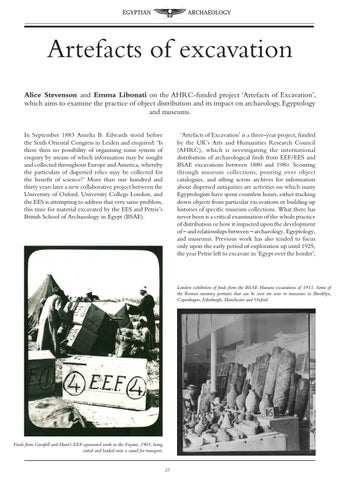
Finds from Grenfell and Hunt’s EEF-sponsored work in the Fayum, 1901, being crated and loaded onto a camel for transport.
27