EGYPTIAN
ARCHAEOLOGY
Detail: sea monster from a Perseus and Andromeda scene.
Four stages of painting Polis.
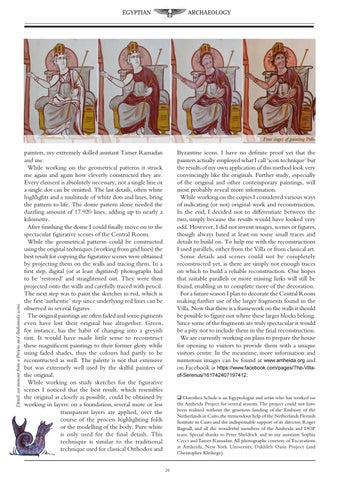
painters, my extremely skilled assistant Tamer Ramadan and me. While working on the geometrical patterns it struck me again and again how cleverly constructed they are. Every element is absolutely necessary, not a single line or a single dot can be omitted. The last details, often white highlights and a multitude of white dots and lines, bring the pattern to life. The dome pattern alone needed the dazzling amount of 17.920 lines, adding up to nearly a kilometre. After finishing the dome I could finally move on to the spectacular figurative scenes of the Central Room. While the geometrical patterns could be constructed using the original techniques (working from grid lines) the best result for copying the figurative scenes were obtained by projecting them on the walls and tracing them. In a first step, digital (or at least digitized) photographs had to be ‘restored’ and straightened out. They were then projected onto the walls and carefully traced with pencil. The next step was to paint the sketches in red, which is the first ‘authentic’ step since underlying red lines can be observed in several figures. The original paintings are often faded and some pigments even have lost their original hue altogether. Green, for instance, has the habit of changing into a greyish tint. It would have made little sense to reconstruct these magnificent paintings to their former glory while using faded shades, thus the colours had partly to be reconstructed as well. The palette is not that extensive but was extremely well used by the skilful painters of the original. While working on study sketches for the figurative scenes I noticed that the best result, which resembles the original as closely as possible, could be obtained by working in layers: on a foundation, several more or less transparent layers are applied, over the course of the process highlighting folds or the modelling of the body. Pure white is only used for the final details. This technique is similar to the traditional technique used for classical Orthodox and
Byzantine icons. I have no definite proof yet that the painters actually employed what I call ‘icon technique’ but the results of my own application of this method look very convincingly like the originals. Further study, especially of the original and other contemporary paintings, will most probably reveal more information. While working on the copies I considered various ways of indicating (or not) original work and reconstruction. In the end, I decided not to differentiate between the two, simply because the results would have looked very odd. However, I did not invent images, scenes or figures, though always based at least on some small traces and details to build on. To help me with the reconstructions I used parallels, either from the Villa or from classical art. Some details and scenes could not be completely reconstructed yet, as there are simply not enough traces on which to build a reliable reconstruction. One hopes that suitable parallels or more missing links will still be found, enabling us to complete more of the decoration. For a future season I plan to decorate the Central Room making further use of the larger fragments found in the Villa. Now that there is a framework on the walls it should be possible to figure out where these larger blocks belong. Since some of the fragments are truly spectacular it would be a pity not to include them in the final reconstruction. We are currently working on plans to prepare the house for opening to visitors to provide them with a unique visitors centre. In the meantime, more information and numerous images can be found at www.amheida.org and on Facebook at https://www.facebook.com/pages/The-Villaof-Serenus/161742407197412.
Dorothea Schulz is an Egyptologist and artist who has worked on the Amheida Project for several seasons. The project could not have been realized without the generous funding of the Embassy of the Netherlands in Cairo, the tremendous help of the Netherlands Flemish Institute in Cairo and the indispensable support of its director, Roger Bagnall, and all the wonderful members of the Amheida and DOP team. Special thanks to Peter Sheldrick and to my assistants Sophia Cecci and Tamer Ramadan. All photographs courtesy of Excavations at Amheida, New York University, Dakhleh Oasis Project (and Christopher Kleihege). 26