EGYPTIAN
ARCHAEOLOGY
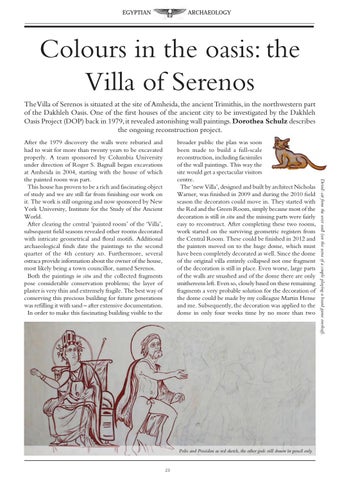
Colours in the oasis: the Villa of Serenos The Villa of Serenos is situated at the site of Amheida, the ancient Trimithis, in the northwestern part of the Dakhleh Oasis. One of the first houses of the ancient city to be investigated by the Dakhleh Oasis Project (DOP) back in 1979, it revealed astonishing wall paintings. Dorothea Schulz describes the ongoing reconstruction project. broader public the plan was soon been made to build a full-scale reconstruction, including facsimiles of the wall paintings. This way the site would get a spectacular visitors centre. The ‘new Villa’, designed and built by architect Nicholas Warner, was finished in 2009 and during the 2010 field season the decorators could move in. They started with the Red and the Green Room, simply because most of the decoration is still in situ and the missing parts were fairly easy to reconstruct. After completing these two rooms, work started on the surviving geometric registers from the Central Room. These could be finished in 2012 and the painters moved on to the huge dome, which must have been completely decorated as well. Since the dome of the original villa entirely collapsed not one fragment of the decoration is still in place. Even worse, large parts of the walls are smashed and of the dome there are only smithereens left. Even so, closely based on these remaining fragments a very probable solution for the decoration of the dome could be made by my colleague Martin Hense and me. Subsequently, the decoration was applied to the dome in only four weeks time by no more than two
Polis and Poseidon as red sketch, the other gods still drawn in pencil only.
23
Detail: cat from the west wall (see the scene of a couple playing a board game overleaf).
After the 1979 discovery the walls were reburied and had to wait for more than twenty years to be excavated properly. A team sponsored by Columbia University under direction of Roger S. Bagnall began excavations at Amheida in 2004, starting with the house of which the painted room was part. This house has proven to be a rich and fascinating object of study and we are still far from finishing our work on it. The work is still ongoing and now sponsored by New York University, Institute for the Study of the Ancient World. After clearing the central ‘painted room’ of the ‘Villa’, subsequent field seasons revealed other rooms decorated with intricate geometrical and floral motifs. Additional archaeological finds date the paintings to the second quarter of the 4th century ad. Furthermore, several ostraca provide information about the owner of the house, most likely being a town councillor, named Serenos. Both the paintings in situ and the collected fragments pose considerable conservation problems; the layer of plaster is very thin and extremely fragile. The best way of conserving this precious building for future generations was refilling it with sand – after extensive documentation. In order to make this fascinating building visible to the