EGYPTIAN
ARCHAEOLOGY
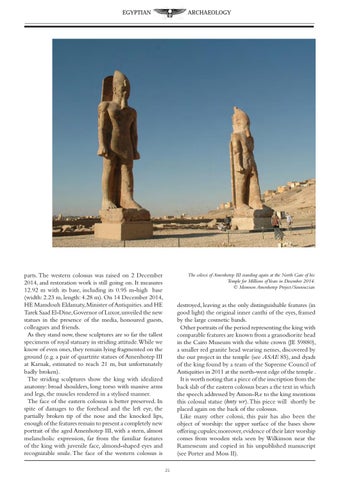
parts. The western colossus was raised on 2 December 2014, and restoration work is still going on. It measures 12.92 m with its base, including its 0.95 m-high base (width: 2.23 m, length: 4.28 m). On 14 December 2014, HE Mamdouh Eldamaty, Minister of Antiquities. and HE Tarek Saad El-Dine, Governor of Luxor, unveiled the new statues in the presence of the media, honoured guests, colleagues and friends. As they stand now, these sculptures are so far the tallest specimens of royal statuary in striding attitude.While we know of even ones, they remain lying fragmented on the ground (e.g. a pair of quartzite statues of Amenhotep III at Karnak, estimated to reach 21 m, but unfortunately badly broken). The striding sculptures show the king with idealized anatomy: broad shoulders, long torso with massive arms and legs, the muscles rendered in a stylised manner. The face of the eastern colossus is better preserved. In spite of damages to the forehead and the left eye, the partially broken tip of the nose and the knocked lips, enough of the features remain to present a completely new portrait of the aged Amenhotep III, with a stern, almost melancholic expression, far from the familiar features of the king with juvenile face, almond-shaped eyes and recognizable smile. The face of the western colossus is
The colossi of Amenhotep III standing again at the North Gate of his Temple for Millions of Years in December 2014. Š Memnon Amenhotep Project/Sourouzian
destroyed, leaving as the only distinguishable features (in good light) the original inner canthi of the eyes, framed by the large cosmetic bands. Other portraits of the period representing the king with comparable features are known from a granodiorite head in the Cairo Museum with the white crown (JE 59880), a smaller red granite head wearing nemes, discovered by the our project in the temple (see ASAE 85), and dyads of the king found by a team of the Supreme Council of Antiquities in 2011 at the north-west edge of the temple . It is worth noting that a piece of the inscription from the back slab of the eastern colossus bears a the text in which the speech addressed by Amon-Re to the king mentions this colossal statue (hnty wr). This piece will shortly be placed again on the back of the colossus. Like many other colossi, this pair has also been the object of worship: the upper surface of the bases show offering cupules; moreover, evidence of their later worship comes from wooden stela seen by Wilkinson near the Ramesseum and copied in his unpublished manuscript (see Porter and Moss II). 21