EGYPTIAN
ARCHAEOLOGY
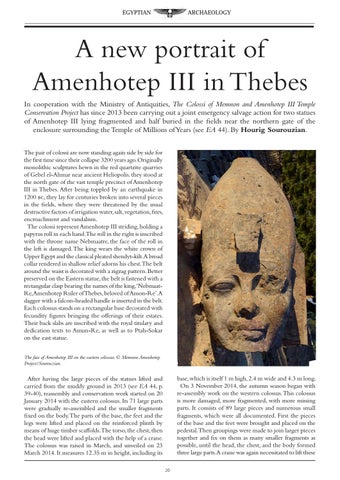
A new portrait of Amenhotep III in Thebes In cooperation with the Ministry of Antiquities, The Colossi of Memnon and Amenhotep III Temple Conservation Project has since 2013 been carrying out a joint emergency salvage action for two statues of Amenhotep III lying fragmented and half buried in the fields near the northern gate of the enclosure surrounding the Temple of Millions of Years (see EA 44). By Hourig Sourouzian. The pair of colossi are now standing again side by side for the first time since their collapse 3200 years ago. Originally monolithic sculptures hewn in the red quartzite quarries of Gebel el-Ahmar near ancient Heliopolis. they stood at the north gate of the vast temple precinct of Amenhotep III in Thebes. After being toppled by an earthquake in 1200 bc, they lay for centuries broken into several pieces in the fields, where they were threatened by the usual destructive factors of irrigation water, salt, vegetation, fires, encroachment and vandalism. The colossi represent Amenhotep III striding, holding a papyrus roll in each hand.The roll in the right is inscribed with the throne name Nebmaatre, the face of the roll in the left is damaged. The king wears the white crown of Upper Egypt and the classical pleated shendyt-kilt.A broad collar rendered in shallow relief adorns his chest.The belt around the waist is decorated with a zigzag pattern. Better preserved on the Eastern statue, the belt is fastened with a rectangular clasp bearing the names of the king,‘NebmaatRe,Amenhotep Ruler of Thebes, beloved of Amon-Re’.A dagger with a falcon-headed handle is inserted in the belt. Each colossus stands on a rectangular base decorated with fecundity figures bringing the offerings of their estates. Their back slabs are inscribed with the royal titulary and dedication texts to Amun-Re, as well as to Ptah-Sokar on the east statue. The face of Amenhotep III on the eastern colossus. Š Memnon Amenhotep Project/Sourouzian.
base, which is itself 1 m high, 2.4 m wide and 4.3 m long. On 3 November 2014, the autumn season began with re-assembly work on the western colossus. This colossus is more damaged, more fragmented, with more missing parts. It consists of 89 large pieces and numerous small fragments, which were all documented. First the pieces of the base and the feet were brought and placed on the pedestal.Then groupings were made to join larger pieces together and fix on them as many smaller fragments as possible, until the head, the chest, and the body formed three large parts.A crane was again necessitated to lift these
After having the large pieces of the statues lifted and carried from the muddy ground in 2013 (see EA 44, p. 39-40), reassembly and conservation work started on 20 January 2014 with the eastern colossus. Its 71 large parts were gradually re-assembled and the smaller fragments fixed on the body. The parts of the base, the feet and the legs were lifted and placed on the reinforced plinth by means of huge timber scaffolds.The torso, the chest, then the head were lifted and placed with the help of a crane. The colossus was raised in March, and unveiled on 23 March 2014. It measures 12.35 m in height, including its 20