EGYPTIAN
ARCHAEOLOGY
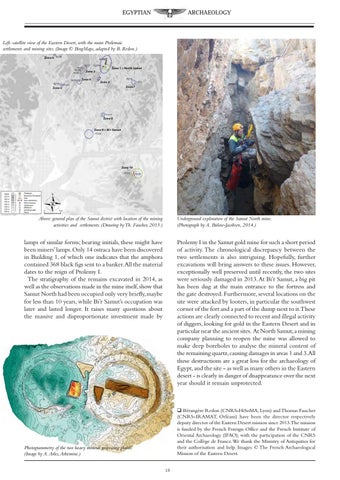
Left: satellite view of the Eastern Desert, with the main Ptolemaic settlements and mining sites. (Image © BingMaps, adapted by B. Redon.)
Underground exploration of the Samut North mine. (Photograph by A. Bülow-Jacobsen, 2014.)
Above: general plan of the Samut district with location of the mining activities and settlements. (Drawing by Th. Faucher, 2013.)
lamps of similar forms; bearing initials, these might have been miners’ lamps. Only 14 ostraca have been discovered in Building 1, of which one indicates that the amphora contained 368 black figs sent to a banker. All the material dates to the reign of Ptolemy I. The stratigraphy of the remains excavated in 2014, as well as the observations made in the mine itself, show that Samut North had been occupied only very briefly, maybe for less than 10 years, while Bi’r Samut’s occupation was later and lasted longer. It raises many questions about the massive and disproportionate investment made by
Ptolemy I in the Samut gold mine for such a short period of activity. The chronological discrepancy between the two settlements is also intriguing. Hopefully, further excavations will bring answers to these issues. However, exceptionally well preserved until recently, the two sites were seriously damaged in 2013. At Bi’r Samut, a big pit has been dug at the main entrance to the fortress and the gate destroyed. Furthermore, several locations on the site were attacked by looters, in particular the southwest corner of the fort and a part of the dump next to it.These actions are clearly connected to recent and illegal activity of diggers, looking for gold in the Eastern Desert and in particular near the ancient sites. At North Samut, a mining company planning to reopen the mine was allowed to make deep boreholes to analyse the mineral content of the remaining quartz, causing damages in areas 1 and 3.All these destructions are a great loss for the archaeology of Egypt, and the site - as well as many others in the Eastern desert - is clearly in danger of disappearance over the next year should it remain unprotected.
Bérangère Redon (CNRS-HiSoMA, Lyon) and Thomas Faucher (CNRS-IRAMAT, Orléans) have been the director respectively deputy director of the Eastern Desert mission since 2013.The mission is funded by the French Foreign Office and the French Institute of Oriental Archaeology (IFAO), with the participation of the CNRS and the Collège de France. We thank the Ministry of Antiquities for their authorisation and help. Images: © The French Archaeological Mission of the Eastern Desert.
Photogrammetry of the two heavy mineral processing plants. (Image by A. Arles, Arkemine.) 19