EGYPTIAN
ARCHAEOLOGY
four angle towers (of which three remain) and two gates. While we did not excavate its inside this year, it probably held, among other facilities, a well (‘bi’r’) that has given the site its name. In 2014, J.-P. Brun excavated the two rubbish dumps located northeast and northwest of the fort, close to the gates and in great danger of looting.They were particularly rich in ceramics (studied by J. Gates-Foster) and ostraca (389, written both in Greek and demotic, have been registered by A. Bülow-Jacobsen, M.-P. Chaufray, H. Cuvigny). With the few coins discovered in the same context, they show that the fort was occupied in the Early Ptolemaic Period (but probably later than at North Samut) until the end of the 3rd century bc. So far no connection with any gold-mining activity is mentioned in the ostraca, which deal mainly with food and water distribution. North Samut is located 5 km to the north. Far less known, except from recent descriptions by S. Sidebotham, and D. and R. Klemm, it is the heart of the Ptolemaic gold exploitation area, centred around its main mine. It consists of a quartz vein visible from the surface, exploited for a stretch of 277 m.Ancient works can clearly be seen, in the form of a surface trench, the upper part of which is empty. The lower part is full of stones and sand, and did not allow a complete view of the ancient activities. However, an underground survey has been conducted by Fl.Téreygeol, A.Arles and J. Gauthier in four shafts, their depths ranging from 13 to 64 m. Ptolemaic works are observable only in the upper part of the shafts, between the surface and a deoth of 18 m.The trench was exploited from the surface continuously on a 10 m-stretch, and several galleries can be observed in the lower part. Below 18 m, mining activity is definitely modern, probably carried out by a British company that worked in Samut in 1903. One hundred metres southeast stands the main structure of the area (n° 1 on the plan), measuring 58 x 36 m. Its four wings were rationally organised: the western one housed the kitchen (fig. 8) and probably a dining room;
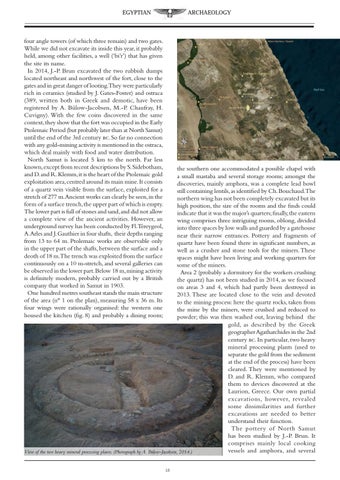
the southern one accommodated a possible chapel with a small mastaba and several storage rooms; amongst the discoveries, mainly amphora, was a complete lead bowl still containing lentils, as identified by Ch. Bouchaud.The northern wing has not been completely excavated but its high position, the size of the rooms and the finds could indicate that it was the major’s quarters; finally, the eastern wing comprises three intriguing rooms, oblong, divided into three spaces by low walls and guarded by a gatehouse near their narrow entrances. Pottery and fragments of quartz have been found there in significant numbers, as well as a crusher and stone tools for the miners. These spaces might have been living and working quarters for some of the miners. Area 2 (probably a dormitory for the workers crushing the quartz) has not been studied in 2014, as we focused on areas 3 and 4, which had partly been destroyed in 2013. These are located close to the vein and devoted to the mining process: here the quartz rocks, taken from the mine by the miners, were crushed and reduced to powder; this was then washed out, leaving behind the gold, as described by the Greek geographer Agatharchides in the 2nd century bc. In particular, two heavy mineral processing plants (used to separate the gold from the sediment at the end of the process) have been cleared. They were mentioned by D. and R. Klemm, who compared them to devices discovered at the Laurion, Greece. Our own partial excavations, however, revealed some dissimilarities and further excavations are needed to better understand their function. The pottery of North Samut has been studied by J.-P. Brun. It comprises mainly local cooking vessels and amphora, and several View of the two heavy mineral processing plants. (Photograph by A. Bülow-Jacobsen, 2014.) 18