EGYPTIAN
ARCHAEOLOGY
Gold mining in Early Ptolemaic Egypt The first campaign in the Samut district of the Eastern Desert took place in January 2014. Two main sites excavated by the French team, conducted by Bérangère Redon and Thomas Faucher, are a fortress and a mining district. They date back to the beginning of the Ptolemaic Period and their construction is closely linked with the exploitation of gold mines nearby. Gold was plentiful in Egypt and had been used by the pharaohs as a means of asserting their power. Abundant particularly in the Eastern Desert (in a wide definition, including the Northern Sudan), gold is mined in the area as early as the Predynastic Period. From the Old Kingdom onward, campaigns are launched by the pharaohs, taking the form of seasonal, often short-lived operations.They are at first limited to the search for alluvial gold in the wadis, but progressively gold quartz is also extracted from visible veins. The New Kingdom is a period of development for these activities; it is in the Ptolemaic Period that the state initiates for the first time a systematic and intensive exploitation of the Egyptian gold-bearing veins, to consolidate its power and pursue an ambitious foreign policy. This intensification is also made possible by the use of iron tools, replacing lithic tools, and more efficient grinding mills.The Roman era is a period of decline and the next peak in activity occurs in Omayyad. times. The last renewal of the gold mining is modern and a gold rush has been occuring in the region since the revolution of 2011, with a deep impact on the area’s heritage.
As for Antiquity, while the continuous use of gold in Egyptian art has produced a considerable literature, the actual history of Egyptian gold - the mining, the production, the circulation - is a lot less well known. Of course, surveys have been conducted in the area since the 19th century by pioneer travellers and geologists (Linant de Bellefonds, Benzoni, Wilkinson, and others), followed by more scientific missions (led by G. Castel, H. Wright, S. Sidebotham, or D. and R. Klemm). But so far no stratigraphical excavations of a gold mining site have been conducted, except at the mainly Byzantine site of Bi’r Umm el-Fawakhir by the Oriental Institute of Chicago in the 1990s. The research project of the French mission of the Eastern desert aims to fill these gaps in our knowledge through the excavation of Samut, a key gold mining district dating back to the Ptolemaic Period, located between Edfu and Marsa Alam.This site has never been explored before and holds crucial data for the understanding of the history and archaeology of Egypt’s gold during one of its major peaks of exploitation.
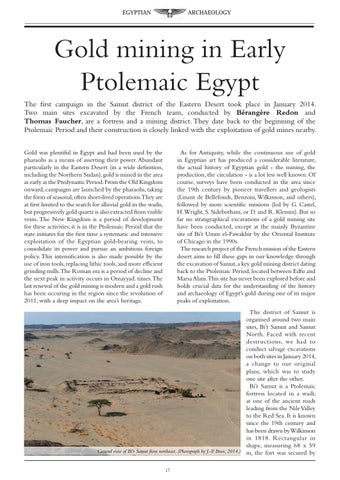
The district of Samut is organised around two main sites, Bi’r Samut and Samut North. Faced with recent destructions, we had to conduct salvage excavations on both sites in January 2014, a change to our original plans, which was to study one site after the other. Bi’r Samut is a Ptolemaic fortress located in a wadi, at one of the ancient roads leading from the Nile Valley to the Red Sea. It is known since the 19th century and has been drawn by Wilkinson in 1818. Rectangular in shape, measuring 68 x 59 General view of Bi’r Samut from northeast. (Photograph by J.-P. Brun, 2014.) m, the fort was secured by 17