EGYPTIAN
ARCHAEOLOGY
are also well represented in the fragment corpus, with groups of blocks from the Twenty-Fifth and Twenty-Sixth Dynasties, including the destroyed mortuary chapel of Ankhenesneferibre, along with groups representing gates and other structures of the Thirtieth Dynasty and the Ptolemaic period, some of which relate to still-standing structures within or around the temple enclosure. A significant group of blocks dating to the Roman era also includes parts of buildings whose original locations are known, as well as yet unidentified structures. Finally, there are numerous architectural fragments from the Coptic phase, now being catalogued. The architectural details, texts, and iconography preserved in each of these fragment groups will, when analyzed, add substantially to our understanding of the stages of this site’s history. Almost 90 years after the Architectural Survey began its excavation of Medinet Habu, our study of the site remains a work in progress.
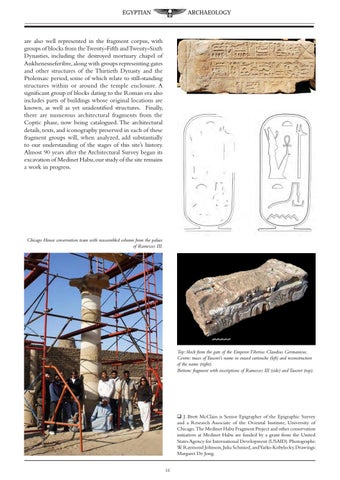
Chicago House conservation team with reassembled column from the palace of Ramesses III.
Top: block from the gate of the Emperor Tiberius Claudius Germanicus. Centre: traces of Tausret’s name in erased cartouche (left) and reconstruction of the name (right). Bottom: fragment with inscriptions of Ramesses III (side) and Tausret (top).
J. Brett McClain is Senior Epigrapher of the Epigraphic Survey and a Research Associate of the Oriental Institute, University of Chicago. The Medinet Habu Fragment Project and other conservation initiatives at Medinet Habu are funded by a grant from the United States Agency for International Development (USAID). Photographs: W. Raymond Johnson, Julia Schmied, and Yarko Kobylecky. Drawings: Margaret De Jong. 16