EGYPTIAN
ARCHAEOLOGY
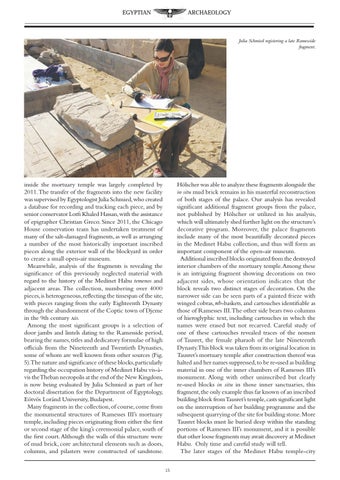
Julia Schmied registering a late Ramesside fragment.
inside the mortuary temple was largely completed by 2011. The transfer of the fragments into the new facility was supervised by Egyptologist Julia Schmied, who created a database for recording and tracking each piece, and by senior conservator Lotfi Khaled Hassan, with the assistance of epigrapher Christian Greco. Since 2011, the Chicago House conservation team has undertaken treatment of many of the salt-damaged fragments, as well as arranging a number of the most historically important inscribed pieces along the exterior wall of the blockyard in order to create a small open-air museum. Meanwhile, analysis of the fragments is revealing the significance of this previously neglected material with regard to the history of the Medinet Habu temenos and adjacent areas. The collection, numbering over 4000 pieces, is heterogeneous, reflecting the timespan of the site, with pieces ranging from the early Eighteenth Dynasty through the abandonment of the Coptic town of Djeme in the 9th century ad. Among the most significant groups is a selection of door jambs and lintels dating to the Ramesside period, bearing the names, titles and dedicatory formulae of high officials from the Nineteenth and Twentieth Dynasties, some of whom are well known from other sources (Fig. 5).The nature and significance of these blocks, particularly regarding the occupation history of Medinet Habu vis-àvis the Theban necropolis at the end of the New Kingdom, is now being evaluated by Julia Schmied as part of her doctoral dissertation for the Department of Egyptology, Eötvös Loránd University, Budapest. Many fragments in the collection, of course, come from the monumental structures of Ramesses III’s mortuary temple, including pieces originating from either the first or second stage of the king’s ceremonial palace, south of the first court. Although the walls of this structure were of mud brick, core architectural elements such as doors, columns, and pilasters were constructed of sandstone.
Hölscher was able to analyze these fragments alongside the in situ mud brick remains in his masterful reconstruction of both stages of the palace. Our analysis has revealed significant additional fragment groups from the palace, not published by Hölscher or utilized in his analysis, which will ultimately shed further light on the structure’s decorative program. Moreover, the palace fragments include many of the most beautifully decorated pieces in the Medinet Habu collection, and thus will form an important component of the open-air museum. Additional inscribed blocks originated from the destroyed interior chambers of the mortuary temple. Among these is an intriguing fragment showing decorations on two adjacent sides, whose orientation indicates that the block reveals two distinct stages of decoration. On the narrower side can be seen parts of a painted frieze with winged cobras, nb-baskets, and cartouches identifiable as those of Ramesses III. The other side bears two columns of hieroglyphic text, including cartouches in which the names were erased but not recarved. Careful study of one of these cartouches revealed traces of the nomen of Tausret, the female pharaoh of the late Nineteenth Dynasty.This block was taken from its original location in Tausret’s mortuary temple after construction thereof was halted and her names suppressed, to be re-used as building material in one of the inner chambers of Ramesses III’s monument. Along with other uninscribed but clearly re-used blocks in situ in those inner sanctuaries, this fragment, the only example thus far known of an inscribed building block from Tausret’s temple, casts significant light on the interruption of her building programme and the subsequent quarrying of the site for building stone. More Tausret blocks must lie buried deep within the standing portions of Ramesses III’s monument, and it is possible that other loose fragments may await discovery at Medinet Habu. Only time and careful study will tell. The later stages of the Medinet Habu temple-city 15