EGYPTIAN
ARCHAEOLOGY
Continuing the Medinet Habu Fragment Project Despite a comprehensive reconstruction of the long and complex architectural sequence of MedinetHabu based on work by the Oriental Institute’s Architectural Survey, the study of the walled templecity remains unfinished. J. Brett McClain reports on continuing work on the fragments and small finds by the Oriental Institute’s Epigraphic Survey under W. Raymond Johnson. From 1926 to 1933, the University of Chicago’s Oriental Institute Architectural Survey, directed by Uvo Hölscher, systematically excavated the temple enclosure of Ramesses III at Medinet Habu. The data gathered by Hölscher’s team allowed a comprehensive reconstruction of the long and complex architectural sequence of the walled temple-city, published at an unprecedented level of detail between 1934 and 1954. Nevertheless, the
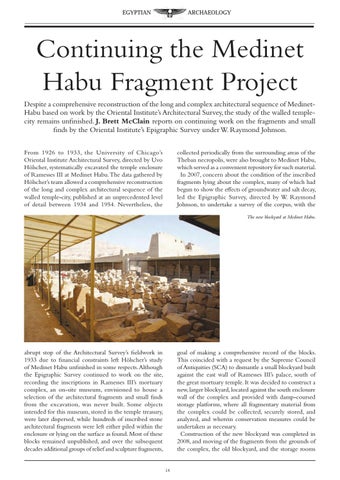
collected periodically from the surrounding areas of the Theban necropolis, were also brought to Medinet Habu, which served as a convenient repository for such material. In 2007, concern about the condition of the inscribed fragments lying about the complex, many of which had begun to show the effects of groundwater and salt decay, led the Epigraphic Survey, directed by W. Raymond Johnson, to undertake a survey of the corpus, with the The new blockyard at Medinet Habu.
abrupt stop of the Architectural Survey’s fieldwork in 1933 due to financial constraints left Hölscher’s study of Medinet Habu unfinished in some respects. Although the Epigraphic Survey continued to work on the site, recording the inscriptions in Ramesses III’s mortuary complex, an on-site museum, envisioned to house a selection of the architectural fragments and small finds from the excavation, was never built. Some objects intended for this museum, stored in the temple treasury, were later dispersed, while hundreds of inscribed stone architectural fragments were left either piled within the enclosure or lying on the surface as found. Most of these blocks remained unpublished, and over the subsequent decades additional groups of relief and sculpture fragments,
goal of making a comprehensive record of the blocks. This coincided with a request by the Supreme Council of Antiquities (SCA) to dismantle a small blockyard built against the east wall of Ramesses III’s palace, south of the great mortuary temple. It was decided to construct a new, larger blockyard, located against the south enclosure wall of the complex and provided with damp-coursed storage platforms, where all fragmentary material from the complex could be collected, securely stored, and analyzed, and wherein conservation measures could be undertaken as necessary. Construction of the new blockyard was completed in 2008, and moving of the fragments from the grounds of the complex, the old blockyard, and the storage rooms 14