EGYPTIAN
ARCHAEOLOGY
of 2.2 m, the drillings hit this hitherto unknown large limestone wall or wall foundation close to the temple axis. In Area 220, where the geophysical prospection covered 60 x 60m, another hitherto unknown structure was detected at a depth of 3 – 4 m, as was suggested by both multi-level resistivity profiling and a concentration of stone debris in the drillings. Further to the west, anthropic construction layers were indicated by a sand foundation of New Kingdom date.
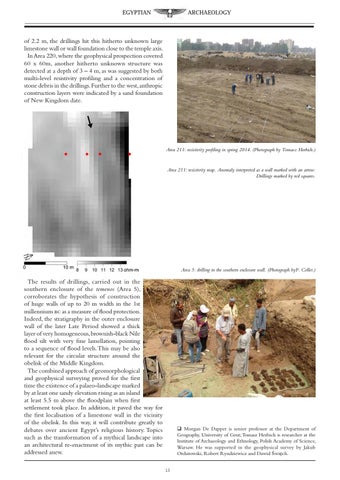
Area 211: resistivity profiling in spring 2014. (Photograph by Tomasz Herbich.)
Area 211: resistivity map. Anomaly interpreted as a wall marked with an arrow. Drillings marked by red squares.
Area 5: drilling in the southern enclosure wall. (Photograph byP. Collet.)
The results of drillings, carried out in the southern enclosure of the temenos (Area 5), corroborates the hypothesis of construction of huge walls of up to 20 m width in the 1st millennium bc as a measure of flood protection. Indeed, the stratigraphy in the outer enclosure wall of the later Late Period showed a thick layer of very homogeneous, brownish-black Nile flood silt with very fine lamellation, pointing to a sequence of flood levels. This may be also relevant for the circular structure around the obelisk of the Middle Kingdom. The combined approach of geomorphological and geophysical surveying proved for the first time the existence of a palaeo-landscape marked by at least one sandy elevation rising as an island at least 5.5 m above the floodplain when first settlement took place. In addition, it paved the way for the first localisation of a limestone wall in the vicinity of the obelisk. In this way, it will contribute greatly to debates over ancient Egypt’s religious history. Topics such as the transformation of a mythical landscape into an architectural re-enactment of its mythic past can be addressed anew.
Morgan De Dapper is senior professor at the Department of Geography, University of Gent; Tomasz Herbich is researcher at the Institute of Archaeology and Ethnology, Polish Academy of Science, Warsaw. He was supported in the geophysical survey by Jakub Ordutowski, Robert Ryndziewicz and Dawid Święch. 13